
Our First Chicken Processing Day: Raising Delaware Chickens for Meat at Rein Maker Ranch Farmstead
22 Delaware chickens, five family members, an 8-year-old chicken masseuse, and one extremely interested farm cat.
By Kristina Picciotti
Rein Maker Ranch Farmstead | Purcell, Oklahoma
There are certain moments when building a farmstead stops feeling like a plan and starts feeling very real.
Processing our first flock of chickens was one of those moments.
We started with 22 Delaware chickens at Rein Maker Ranch Farmstead. Our original plan was to keep roughly half of the hens for eggs and process the others for meat.
But farm plans have a way of changing.
As winter approached, we reconsidered the timing. With shorter daylight hours and colder weather coming, we knew egg production would naturally slow significantly, and these young hens might produce little or no eggs for part of the winter. We decided it made more sense for this first flock to become food for our family.
So all 22 Delawares became our first home-raised chickens for the freezer.
And suddenly everyone had a job.
Our First Flock at a Glance
We raised 22 Delaware chickens as our first meat flock. Our family processed them together using poultry processing cones, a scalder, a mechanical chicken plucker, processing tables, and an ice-water chilling setup.
The Delawares were smaller than the commercial meat chickens most people are used to, but the meat turned out to be exceptionally tender, juicy, and flavorful.
Our next flock will be 40 Cornish Cross chickens, which are bred specifically for meat and should produce larger birds in a shorter amount of time.
But before we get to that, here is how our very first processing day actually went.
No Chopping Block Required
When most people picture processing chickens, they probably imagine an old-fashioned chopping block.
Thankfully, poultry-processing equipment has come a long way.
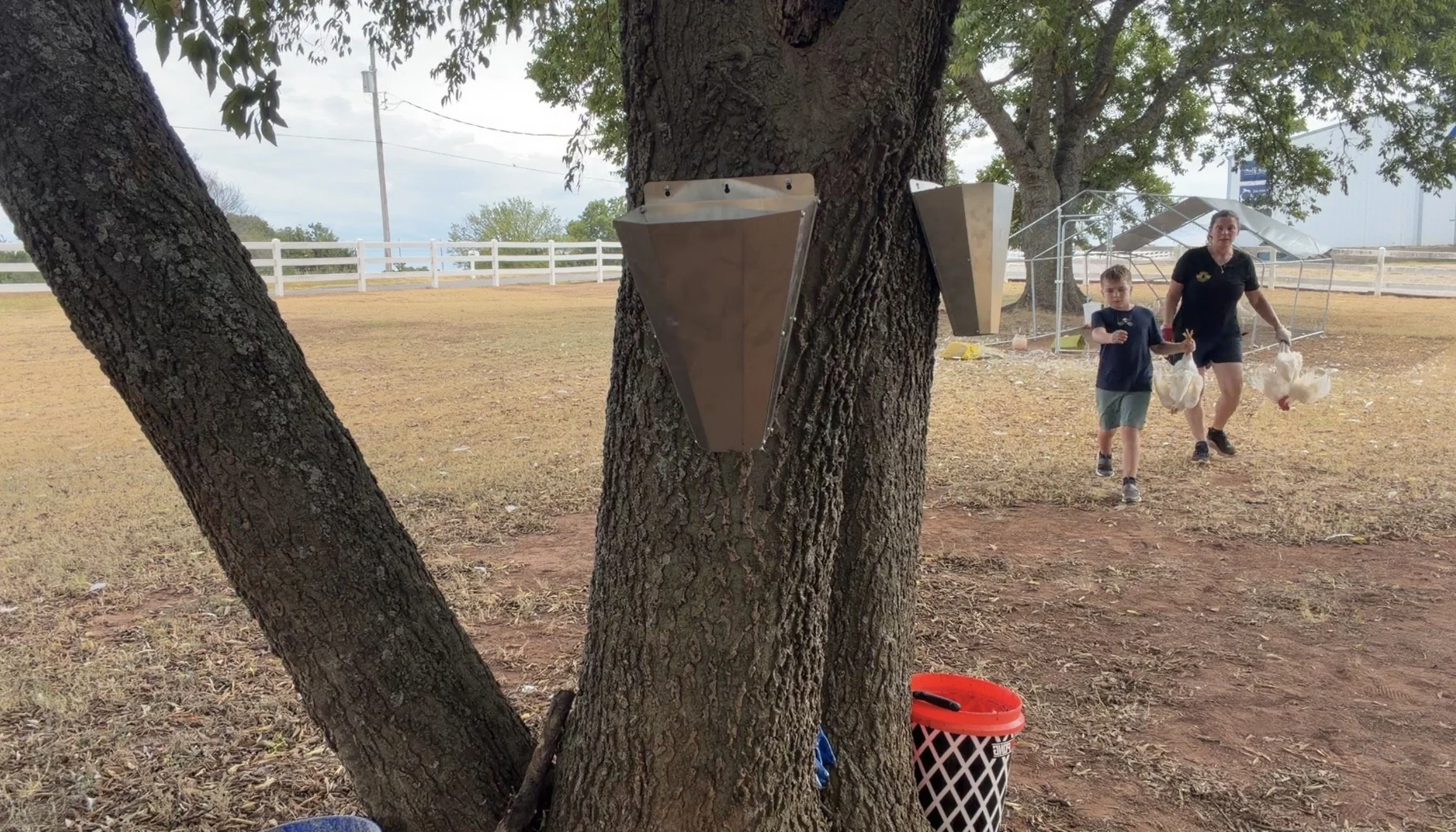
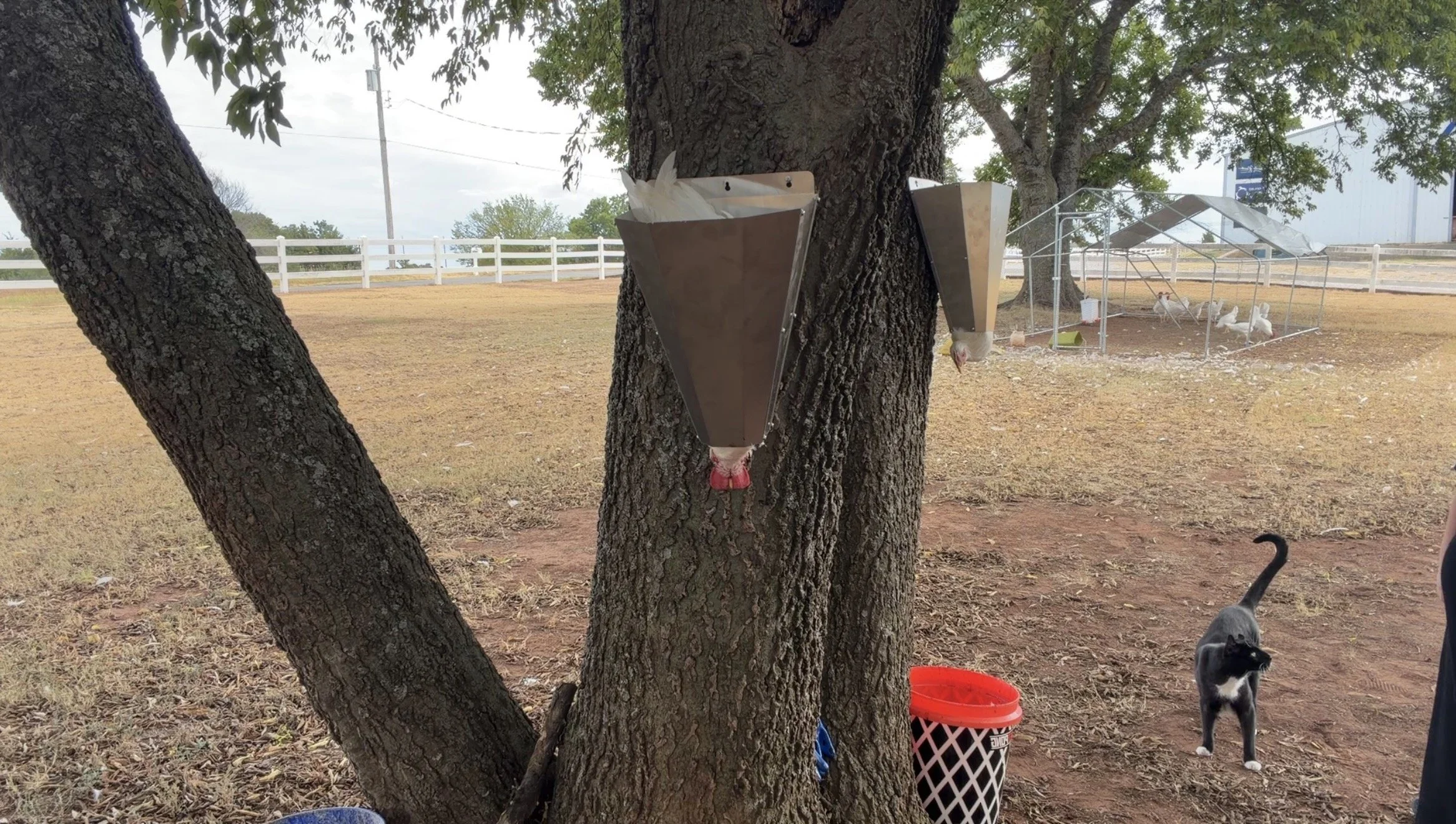
We purchased processing cones, which we mounted securely to one of the large trees on the farm. The chickens are placed head-down inside the cones, which helps keep them contained and makes the process easier to manage.
Seeing stainless-steel poultry cones mounted to a tree was also one of those little moments when we realized that Rein Maker Ranch had officially crossed over into full farmstead territory.
Kristina was responsible for dispatching the chickens.
This was probably the least-requested job of the day.
It is one thing to say you want to raise your own food. It is another thing to accept responsibility for every part of the process, including the part that is not particularly comfortable.
We wanted the birds handled calmly and respectfully, and that meant taking responsibility for the entire process from beginning to end.
Dimitri’s First Farm-to-Table Experience
One of the most memorable parts of the day was watching 8-year-old Dimitri experience all of this for the first time.
He had never seen chickens processed before.
Dimitri spent much of his early childhood near the beach in Florida, so standing beside a tree in Oklahoma while the family processed chickens was a very different kind of day for him.
He is also a genuine animal lover, so we were curious about how he would respond.
He surprised all of us.
He was calm, curious, and incredibly level-headed about the entire process.
Dimitri understood why we were doing it. He understood the idea of farm-to-table food and that these chickens had been raised with care to become food for our family.
But understanding that did not make him any less compassionate toward them.
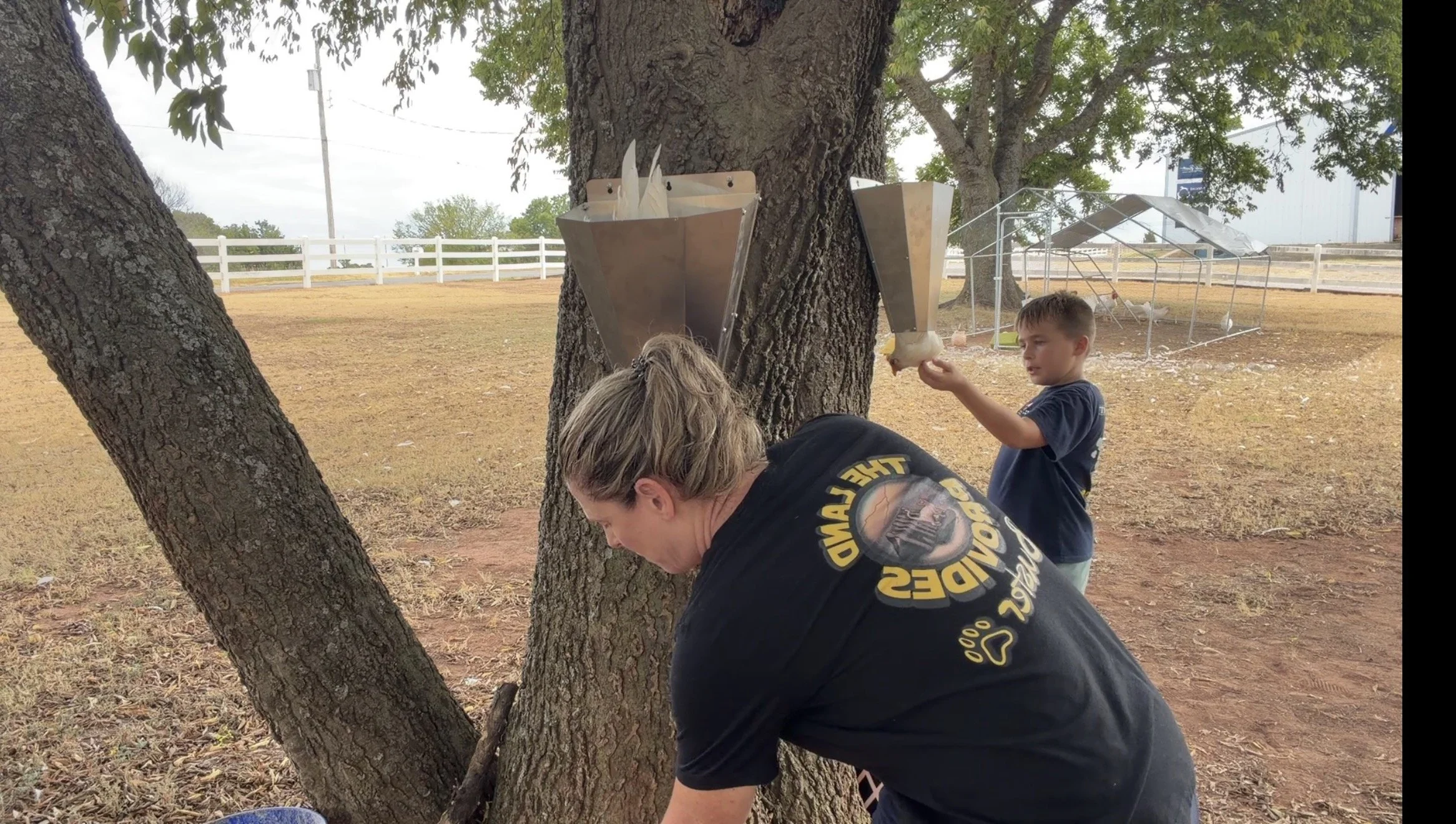
Before Kristina dispatched each chicken, Dimitri insisted on giving it a little neck massage while it rested in the processing cone.
It was one of the sweetest and most unexpected moments of the day.
There he was, eight years old, gently petting and massaging each chicken and making sure it seemed calm before stepping away.
Then, once each bird was dispatched, Dimitri carried it over to the processing area.
For someone seeing the process for the first time, he may have been one of the calmest people there.
It was also a good reminder that understanding where food comes from does not mean becoming disconnected from the animal.
For us, it means the opposite.
Scalding, Plucking, and Finding Our Rhythm
From there, Arianna, Daniela, and Philip worked together through the hands-on processing.
Arianna and Daniela handled much of the scalding and cleaning, while Philip was right in the middle of the process with them—helping move birds through each stage, operating and assisting with the plucker, removing remaining feathers, helping with butchering, and stepping in wherever another set of hands was needed.
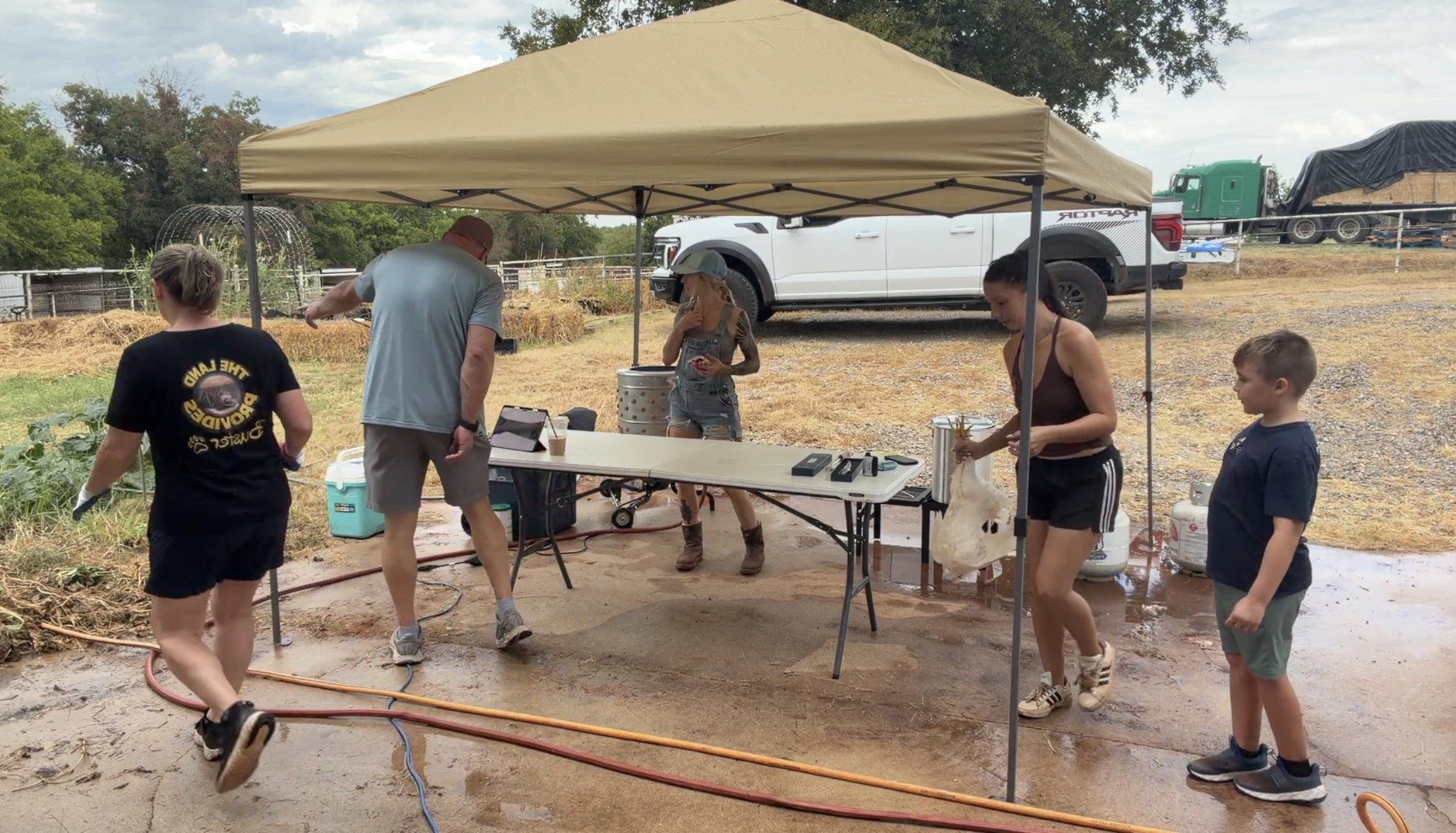
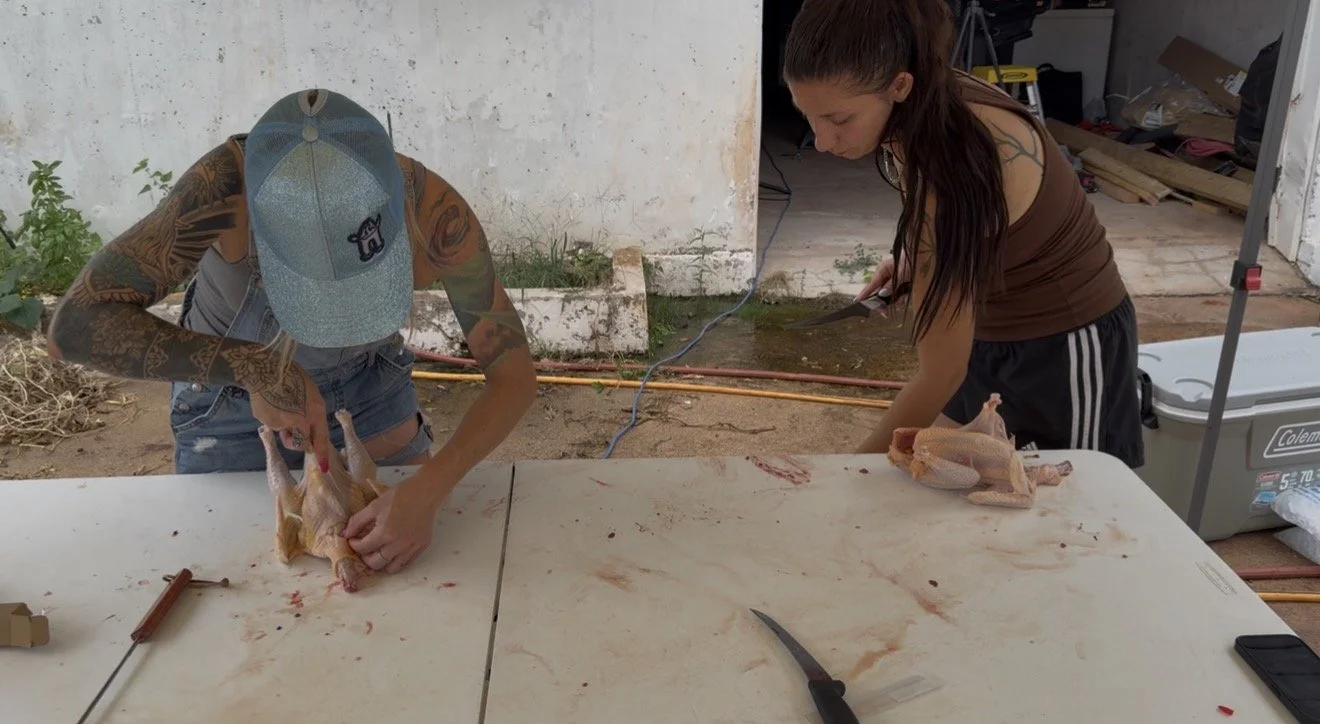
We set up the entire processing area outdoors under a canopy with tables, hoses, coolers, propane burners, the scalder, and our Yardbird chicken plucker.
It looked a little like a farmyard assembly line.
And after the first few birds, that is exactly what it became.
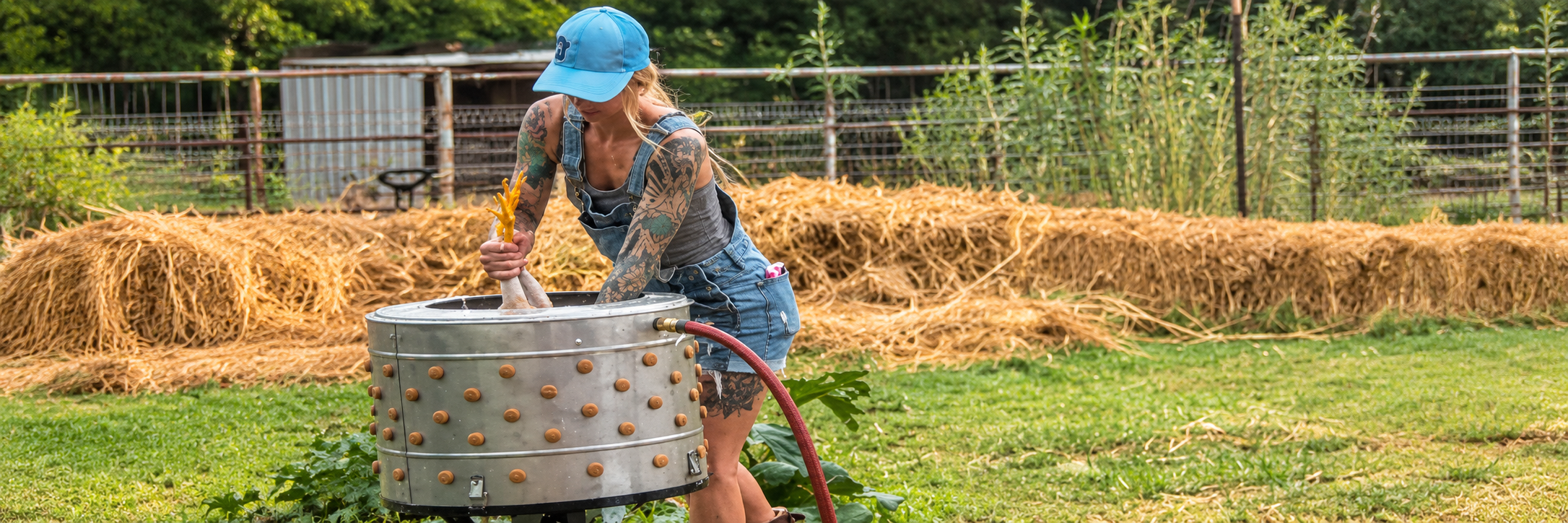
Once each chicken was properly scalded, it went into the plucker.
If you have never watched a mechanical chicken plucker work, it is strangely satisfying.
The drum spins, rubber fingers remove the feathers, and within a surprisingly short amount of time, a fully feathered chicken becomes a mostly featherless one.
It made us appreciate the equipment immediately.
Philip was not simply standing by keeping the machinery running. He was actively processing chickens right alongside Arianna and Daniela.
He helped with the plucker, defeathering, moving birds to the tables, butchering, cleanup, and keeping the flow moving from one stage to the next.
At the same time, he was still the person everyone looked to when a hose kinked, a propane setup needed attention, or a piece of equipment decided not to cooperate.
So his unofficial job title became something along the lines of processing crew, maintenance department, and general problem solver.
The Less Glamorous Part
Once the feathers were removed, the birds moved to the processing tables.
Arianna, Daniela, and Philip worked together on the cleaning, evisceration, and final processing of the birds.
There is no especially elegant way to describe this part.
It is messy.
It takes concentration.
And the first few chickens definitely took longer than the last few.
But one of the most interesting things about the day was watching everyone become more comfortable with their role.
At the beginning, every step required thought.
By the end, we had a system.
Kristina was dispatching.
Arianna, Daniela, and Philip were the processing crew.
Dimitri was transportation and chicken relaxation services.
And then there was management.
Binx, Farmstead Poultry Processing Supervisor
Our farm cat, Binx, followed us around for almost the entire day.
Not casually.
He was invested.
He watched people moving chickens from one station to another.
He watched the scalder.
He watched the plucker.
He watched the processing tables.
And we are fairly certain that, from his perspective, the entire family had finally come to its senses and organized an enormous chicken buffet specifically for him.
It must have been deeply disappointing when he realized that was not the plan.
We could not decide whether he was fascinated, concerned, or simply calculating how many meals 22 chickens represented.
Knowing Binx, probably the last one.
He has since been promoted to Farmstead Poultry Processing Supervisor, although his compensation package remains under negotiation.
Into the Ice Bath
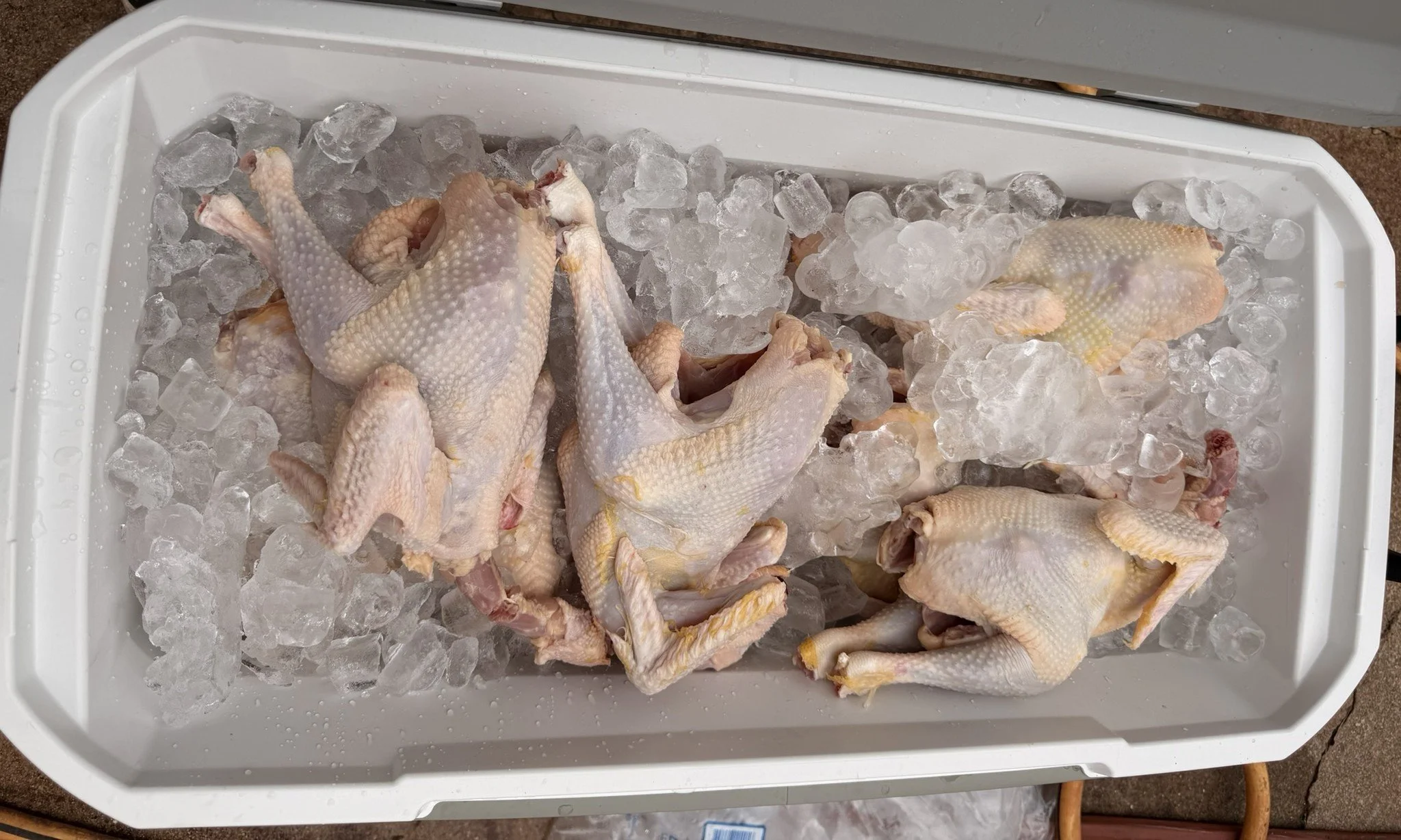
As each bird was cleaned, it went into a large ice-water bath to begin chilling.
By the time we finished the flock, we were wet, tired, and surrounded by hoses, coolers, buckets, folding tables, propane tanks, and processing equipment.
The photos probably tell the story better than anything else.
This was not a perfectly staged homesteading photo shoot.
There were hoses everywhere.
The concrete was wet.
Equipment had been moved around.
Everyone was working.
There was cleanup to do.
There were a few moments of confusion.
There was also a lot of laughing.
And that was one of our favorite parts of the day.
It felt real.
From Chicken to Freezer
We left the chickens chilled overnight.
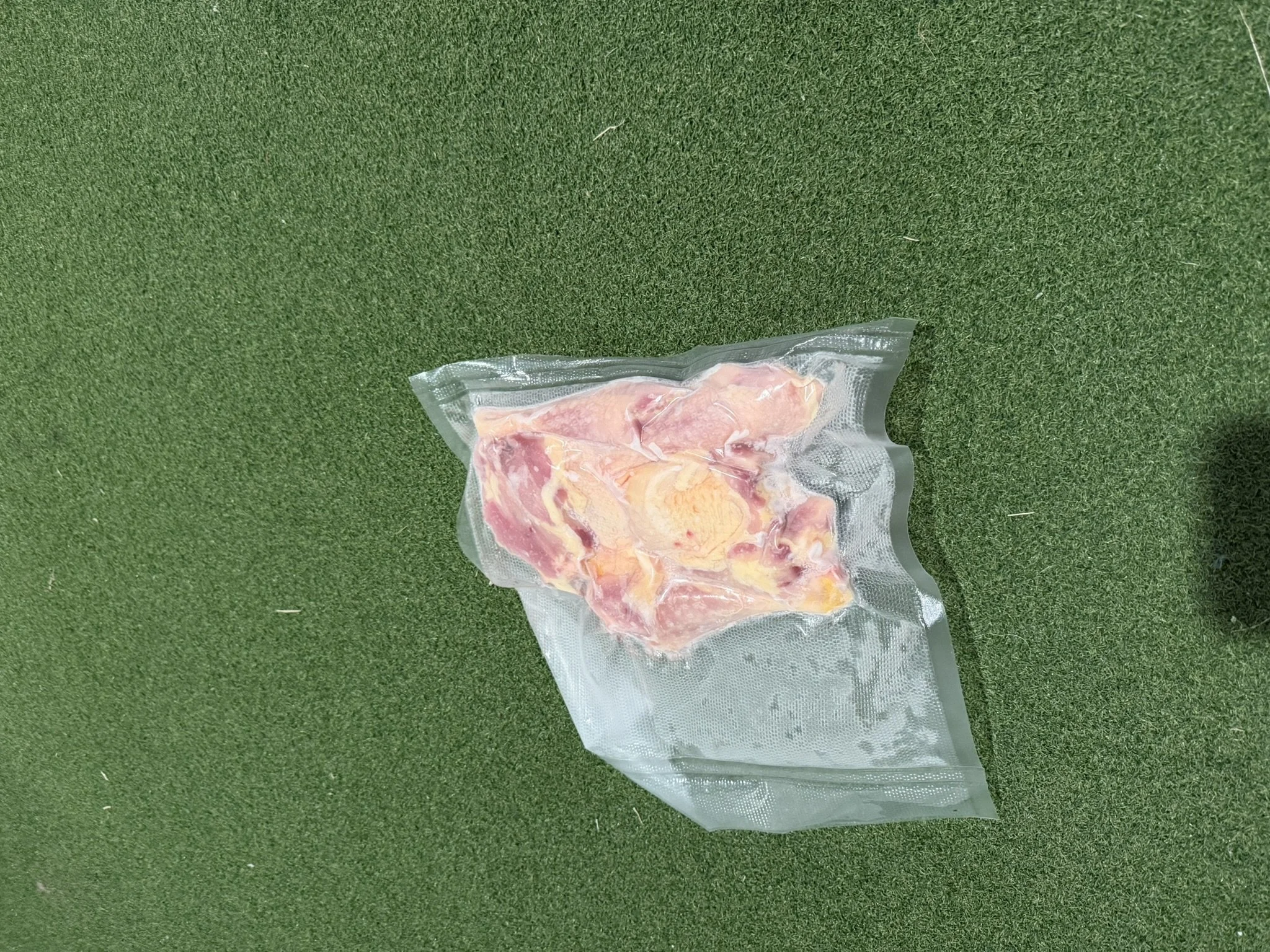
The following day, we removed them from the water, dried them, and cut them into the portions our family uses most often.
Everything was then vacuum-sealed and frozen.
That was probably the moment when the whole experience really came together.
These were chickens we had raised ourselves.
We knew what they ate.
We knew how they were cared for.
We knew who processed them.
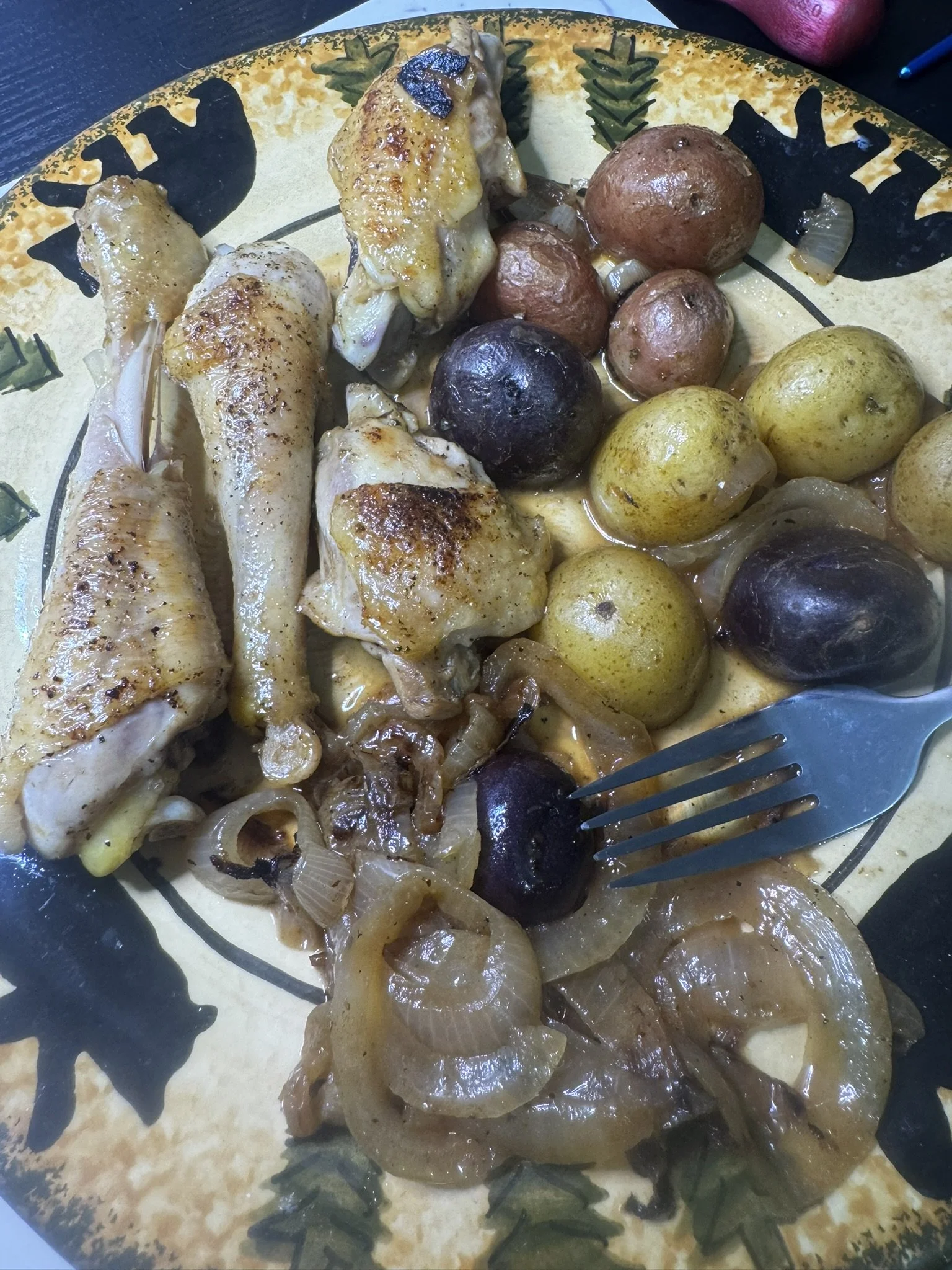
And now they were neatly packaged and going into our freezer to feed our family.
There is something very satisfying about that.
It gives you a different appreciation for food when you understand how much work happened before it reached the dinner table.
What We Learned From Our First 22 Chickens
Our first processing day taught us a lot.
We learned that having assigned jobs makes the process much smoother.
We learned that the processing cones worked well for us and helped keep the process controlled.
We learned that a mechanical plucker saves a tremendous amount of time.
We learned that our outdoor setup worked, although there are already a few things we will arrange differently next time.
And we learned that while Delawares produced excellent meat for our family, we want a larger, more efficient meat bird for the next flock.
That brings us to what is coming next.
Next Up: 40 Cornish Cross Chickens
Our next flock will be 40 Cornish Cross chickens.
Cornish Cross are bred specifically for meat production and grow much faster and larger than a dual-purpose chicken like the Delaware.
Our hope is that they will be ready for processing in approximately 7 to 8 weeks, depending on their growth and condition.
Because we are heading into winter, this next batch will primarily be for our own family.
The goal is simple:
Fill the freezer.
We want to raise enough chicken to supply our family through a good portion of the winter.
And after processing our first flock, we feel much better prepared.
Everyone knows their job now.
Arianna, Daniela, and Philip know how to move the birds through the processing line much more efficiently.
Philip already knows which equipment will probably need his attention before anyone else realizes there is a problem.
Dimitri knows that chicken massage is apparently part of his official farm duties.
And Binx has made it very clear that he is available for the next processing day.
After That, We Begin Raising Chicken for the Farm Store
The next stage is especially exciting for us.
We are currently developing the Rein Maker Ranch Farmstead app and farm store.
Eventually, customers will be able to see what we are growing, raising, producing, and making here at the farm.
One of the products we plan to offer is farm-raised chicken.
Our plan is to begin with a preorder model.
Instead of raising large numbers of birds and hoping they sell later, customers will be able to reserve chicken from an upcoming flock through the farm store.
That will allow us to raise based on actual demand, keep the operation small and manageable, and reduce unnecessary waste.
When the chickens are ready, customers will be able to purchase and pick up their orders directly from the farm.
This Is What Farmstead Means to Us
When we first started developing Rein Maker Ranch Farmstead, the goal was never simply to grow a garden or keep a few chickens.
We wanted to become more involved in producing the food our family eats and to better understand the work behind it.
That means learning things previous generations often knew naturally but many of us have never had to think about.
Which chicken breeds work best for meat?
How much feed does a flock require?
How long does it take to raise them?
How do you process and preserve the food you produce?
How much chicken does your family actually eat in a year?
You look at food differently when you are involved in every step.
And you also quickly realize that real farmstead life is not nearly as polished as it sometimes appears online.
Sometimes it is beautiful gardens and fresh eggs.
Sometimes it is five family members standing under a pop-up canopy with a chicken plucker, coolers, propane burners, garden hoses, and one farm cat who is convinced the entire operation exists for his benefit.
Sometimes it is an 8-year-old boy who grew up near the beach in Florida standing beside a tree in Oklahoma, giving a chicken a neck massage because he thinks it deserves a little kindness before becoming dinner.
Both are farmstead life.
And we like it that way.
Our first flock of 22 Delaware chickens was just the beginning.
We learned a lot.
We will change a few things next time.
We will probably get much faster.
But when we finally sat down and ate that first chicken, knowing exactly where it came from and knowing our family had done the work together from beginning to end, it felt like an important milestone.
Because Rein Maker Ranch Farmstead is not just something we are planning anymore.
We are actually building it.
One garden.
One flock.
One freezer full of chicken.
One 8-year-old chicken masseuse.
And one extremely hopeful farm cat at a time.
Next up: 40 Cornish Cross chickens, another processing day in about 7 to 8 weeks, and the next step toward opening the Rein Maker Ranch Farmstead store.
About Rein Maker Ranch Farmstead
Rein Maker Ranch Farmstead is our family farmstead in Purcell, Oklahoma, where we are learning to raise more of our own food, grow produce, raise poultry and livestock, and share the process as we build toward opening our local farm store.