
Nothing Wasted: Bones, Feet, Heads and Blood
Not a Halloween Tale; A Tale of 22 Chickens
The very first family journey on our farmstead wasn’t elaborate, expensive, or glamorous.
It was, however, our first real milestone toward what we hope Rein Maker Ranch Farmstead will become.
After processing our first flock of 22 Delaware chickens, we were left with something we had never really thought much about before:
A lot of chicken parts.
Not just meat.
Bones….
Feet…
Heads..
Blood.
And a very clear reminder that if you are going to raise your own food, you suddenly become much more aware of what normally gets discarded long before anything reaches a grocery store.
“Nothing wasted” is one of those phrases you hear often in sustainability circles and the farmstead world.
It sounds nice.
It sounds responsible.
It also sounds slightly different when you are standing there looking at 22 chicken heads, 44 feet, a pile of carcasses, and buckets from processing day.
When we say nothing was wasted, we mean it.
Well… almost.
The feathers are another story.
We’ll get to those.
22 Heads
Let’s start with the least glamorous category.
The heads.
Twenty-two of them.
There is really no elegant way to say that.
This was probably the moment when our “farm-to-table” lifestyle became less Pinterest and a little more National Geographic.
But once you start thinking in terms of using the whole animal, even the parts that seem unusual become part of the conversation.
For us, the bigger lesson was simple:
Raising food yourself changes what you consider waste.
Things that would normally be thrown away suddenly make you stop and think.
Can we use this? Should we save this? Is there a purpose for this?
Sometimes the answer is yes.
Sometimes the answer is, “We need to look that up.”
And sometimes the answer is still, “Nope. That one is going away.”
Farmstead life is nothing if not educational.
44 Chicken Feet
The feet had a completely different destination.
All 44 chicken feet were saved and turned into dog treats.
This was another one of those things that probably would have seemed strange to us before we started raising our own food, but once you begin thinking in terms of whole-animal use, it starts to make sense.
Instead of throwing them away, we cleaned and prepared them for the dogs.
Apparently, one chicken’s leftover is another dog’s jackpot.
That was one more part of the bird that did not go to waste and one more reminder that “usable” does not always mean “for us.”
22 Carcasses
This part was much more familiar.
Once the usable meat was removed, we had the carcasses left behind.
And this is where Daniela took over.
Instead of treating the bones as leftovers, she turned them into something we now expect will become a regular staple in our kitchen:
homemade chicken bone broth.
For her first batch, Daniela used five chicken carcasses along with celery, carrots, onions, garlic, whole black peppercorns, and water.
Everything simmered low and slow for hours until the broth became rich, flavorful, and full-bodied.
Then came another new farmstead skill:
pressure canning.
There were a few lessons along the way, including some siphoning with the earlier jars, but eventually Daniela had five beautiful jars come out of the canner without losing a drop.
There may or may not have been an unreasonable amount of excitement over those five jars.
If you have ever learned pressure canning, you probably understand.
One of the best surprises came when a refrigerated jar of broth turned into a thick gel.
That was when we really understood just how different homemade broth made from our own chickens could be.
Suddenly, bones that might once have gone straight into the trash had become jars of broth for soups, stews, sauces, gravy, rice, and future family meals.
And apparently we are now the kind of family that gets excited about gelatinous chicken broth.
Farmstead life sneaks up on you.
Want to Make It Yourself?
Daniela put together the full step-by-step recipe, including the ingredients, simmering process, what she learned during her first batches, and important pressure-canning notes.
→ Read Daniela’s Homemade Chicken Bone Broth Recipe
And Then There Was the Blood
The blood was not discarded either.
We used it in our compost.
That was probably one of the clearest examples of what “nothing wasted” started to mean for us in practice.
Something that could easily have been treated as waste became part of the cycle back into the farmstead.
The chickens helped feed our family.
The bones became broth.
The feet became dog treats.
And the blood went into the compost that will eventually help feed the soil.
That is the kind of loop we want to build more of here.
Not because we are trying to be perfect, but because we want to become more intentional about using what we have.
Why Waste Suddenly Feels Different
One thing we did not expect was how differently we would feel about waste once we had raised the chickens ourselves.
When we bought chicken from the grocery store, it was easy to separate the food from everything that happened before it reached us.
If there was meat left on a carcass, bones we did not use, or something sitting too long in the refrigerator, throwing it away was easy.
We had paid for chicken.
We had not spent weeks feeding it.
We had not carried water to it.
We had not checked on it every day.
We had not watched it grow.
We had not invested our time, money, work, and care into raising it.
And we certainly had not stood together as a family and processed it ourselves.
That changes things.
When you have personally invested that much into producing your food, throwing part of it away suddenly feels very different.
The bones are no longer just bones.
The feet are not simply scraps.
Even the blood makes you stop and ask whether there is somewhere useful for it to go.
There is a sense of responsibility that comes with knowing exactly what went into putting that food on the table.
And we realized that we had become accustomed to waste too.
Food has become incredibly convenient in America.
Most of us can walk into a grocery store, pick up a neatly packaged tray of chicken, take it home, and never think much about the animal, the feed, the labor, the processing, or all the resources that came before that package.
That convenience can make waste easy.
We were guilty of it too.
Until now.
Raising these chickens did not suddenly make us perfect at sustainability, and we do not expect that we will never waste food again.
But it did make us more aware of the value of what we have.
After putting weeks of time, care, money, work, and—yes—love into raising an animal, you naturally want to honor that investment by using as much of it as you reasonably can.
For us, that may end up being one of the most important lessons our first 22 chickens taught us.
Not simply how to raise chicken.
Not simply how to process it.
But how easy it is to undervalue food when you never have to see what it takes to produce it.
And About Those Feathers...
We said almost nothing was wasted.
Almost.
The feathers were the exception.
At least for now.
After processing 22 chickens, there were a lot of them.
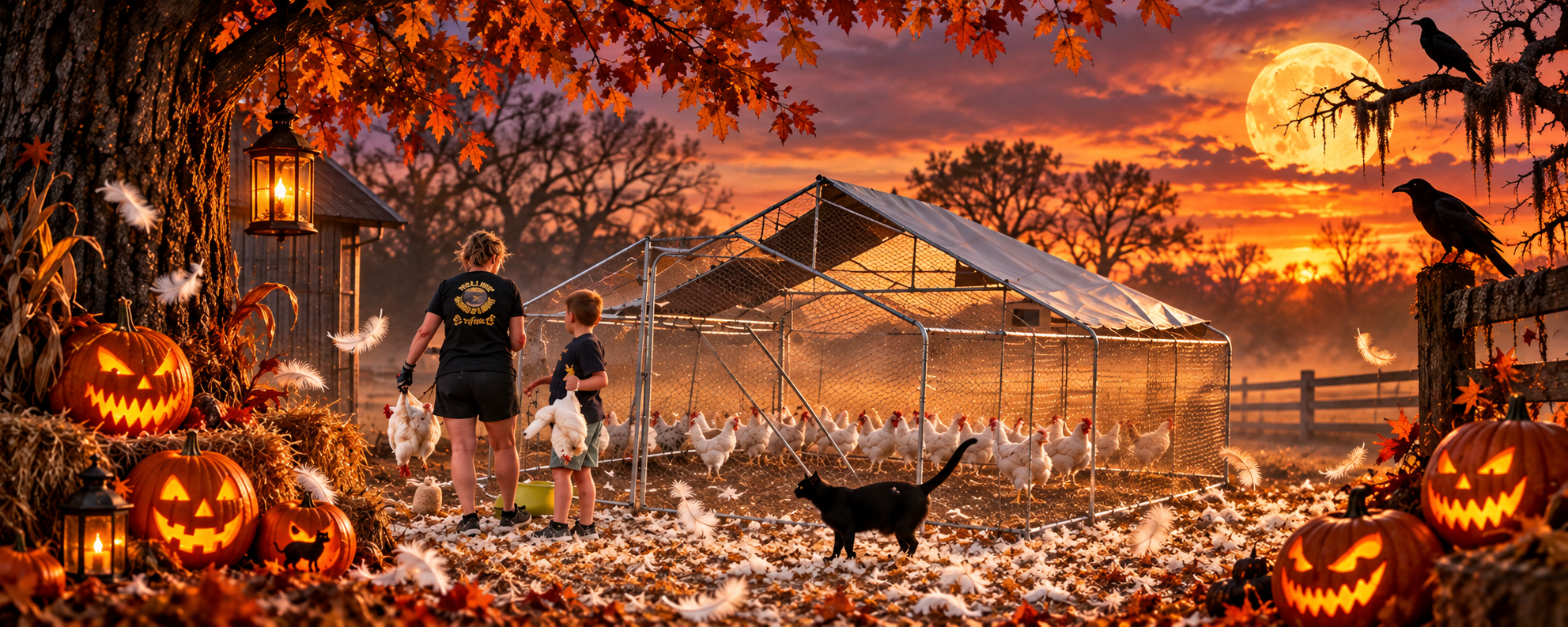
Enough that, for a brief moment, the scene looked less like a farmstead project and more like the aftermath of a very unfortunate Halloween ritual.
If someone had wandered onto the property at exactly the wrong moment, we probably would have had some explaining to do.
The feathers did not make it into broth.
They did not become dog treats.
They did not go into jars.
And unlike the blood, they were not part of our compost plan.
So for now, the feathers remain the one mysterious loose end in our “nothing wasted” experiment.
Perhaps by the next flock we will have figured out a practical use for them.
Or perhaps they will continue to be the slightly spooky evidence left behind after processing day.
Either way, every good farm story needs a little mystery.
Almost Nothing Wasted
By the time we were finished, those 22 chickens had provided far more than just meat for the freezer.
They gave us:
Chicken for family meals
Bones and carcasses for homemade broth
Chicken feet for dog treats
Blood for the compost
New pressure-canning experience
A better understanding of whole-animal use
Less waste overall
A pantry full of homemade broth
And a few more skills we did not have before
The feathers were basically the only part that did not find a second life this time.
We will call that progress.
This Is the Part of Farmstead Life We Love
The first chicken-processing day taught us how to turn a flock into food.
What happened afterward taught us something just as important:
There is a lot more value in an animal than the cuts of meat we are accustomed to seeing in the grocery store.
When you raise the animal yourself, you naturally want to make the most of what it provided.
And that creates a different level of respect for the food.
“Nothing wasted” does not mean we will always use every single thing perfectly.
It means we are learning to look at the entire process differently.
To ask more questions.
To use more.
To waste less.
To learn skills we did not have before.
And occasionally to stand in the kitchen admiring a jar of gelatinous chicken broth like it is a major life accomplishment.
Because apparently that is who we are now.
And we are perfectly fine with it.
Twenty-two chickens. Forty-four dog treats in the making. Twenty-two carcasses for broth. Blood for the compost. One suspiciously large pile of feathers. And one more step toward becoming the farmstead we are trying to build.