
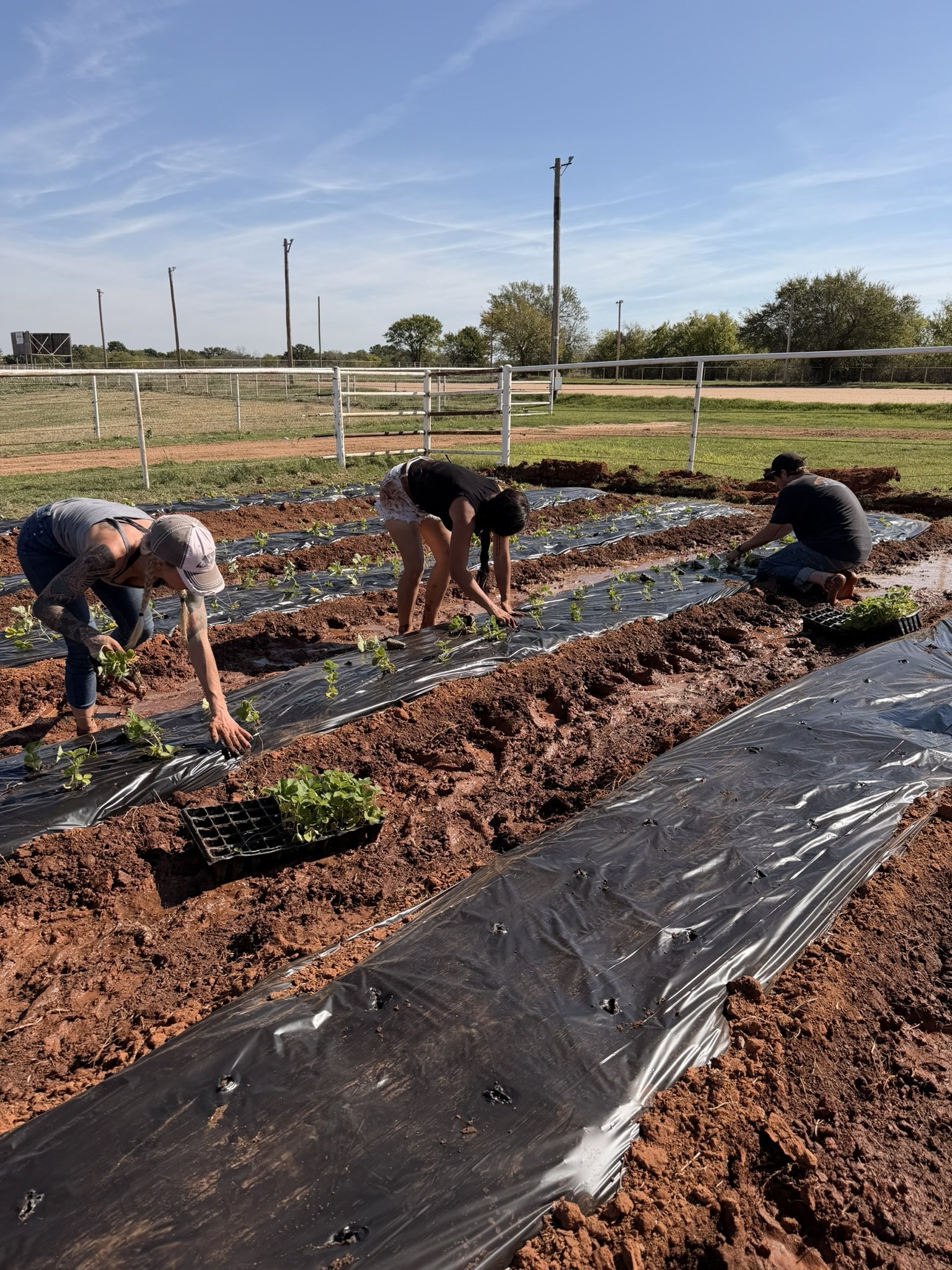
Building Our Strawberry Field: 900 Plants, Five Rows, and a Lot of Mud
We turned a grassy Oklahoma field into five 100-foot strawberry beds and planted 900 strawberry plants in just a few days. Along the way, we learned that tractor buckets beat hand shovels, plastic mulch and Oklahoma wind do not get along, and apparently enough barefoot time in the mud leads to family discussions about deworming.
There are projects that sound very simple when you explain them in one sentence.
“We’re planting strawberries.”
That sounds easy enough.
It does not sound like six people, one friend, a tractor, a disc, an arena drag, poly tubing, plastic mulch, Oklahoma wind, several hours of manual labor, mud up to our ankles, and one family member suggesting we should all probably be dewormed afterward.
But that is, in fact, how we planted our first strawberry field.
Our goal was simple:
Five rows.
100 feet each.
900 strawberry plants.
And somehow, by Saturday, October 24, we got it done.
Step One: Do We Even Have Water?
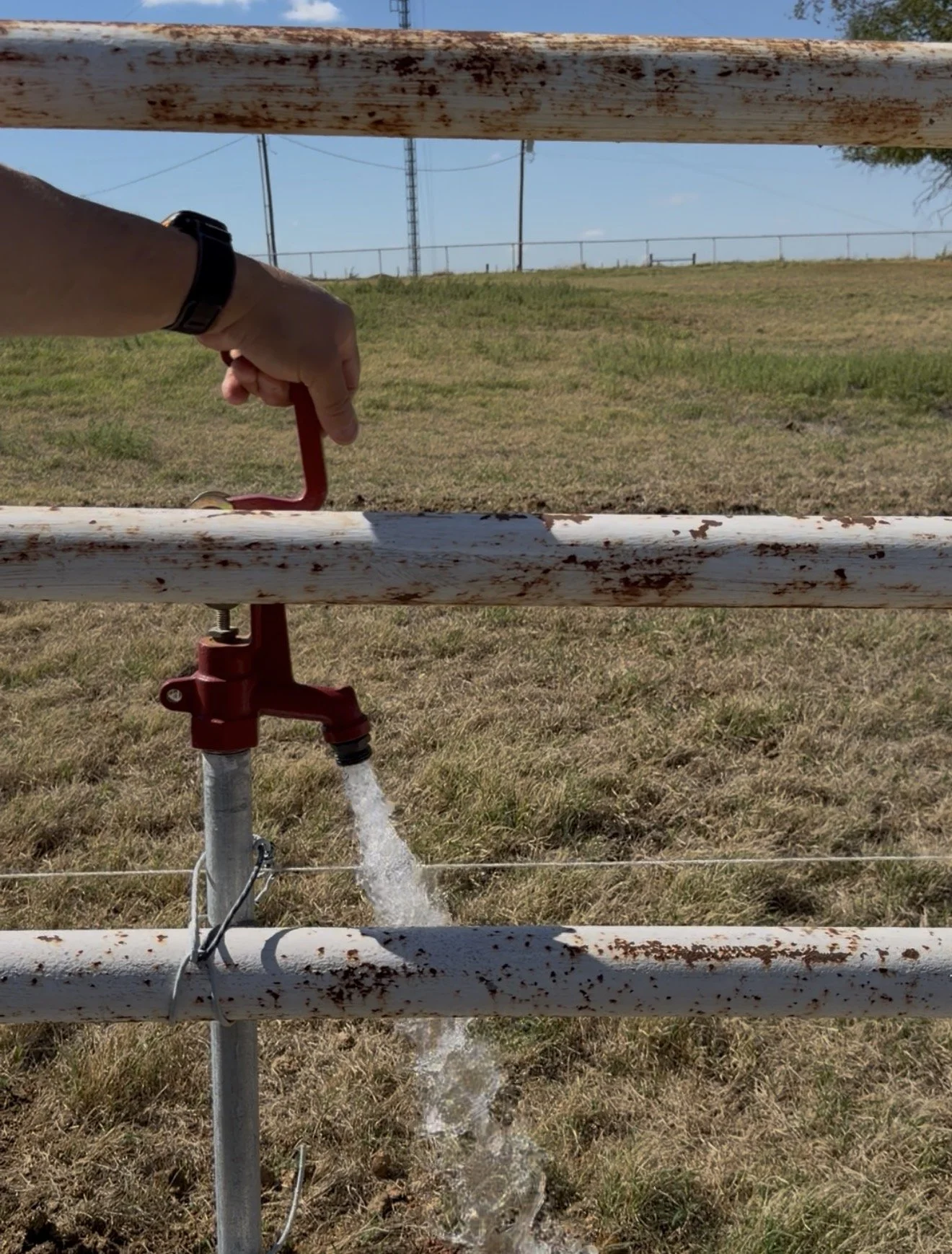
Before we worried about tractors, rows, irrigation, or plastic mulch, we had to answer one very basic question:
Do we actually have water where we need it?
We drove up to a spigot near the field that looked like the best option for connecting our irrigation system.
This was one of those moments where farm planning becomes very practical very quickly.
Before you build 500 feet of strawberry beds, it is generally a good idea to make sure the water source exists.
Fortunately, it did.
Not only did we have water, but the pressure was good.
Excellent.
One problem eliminated.
Approximately 47 remaining.
Preparing the Field
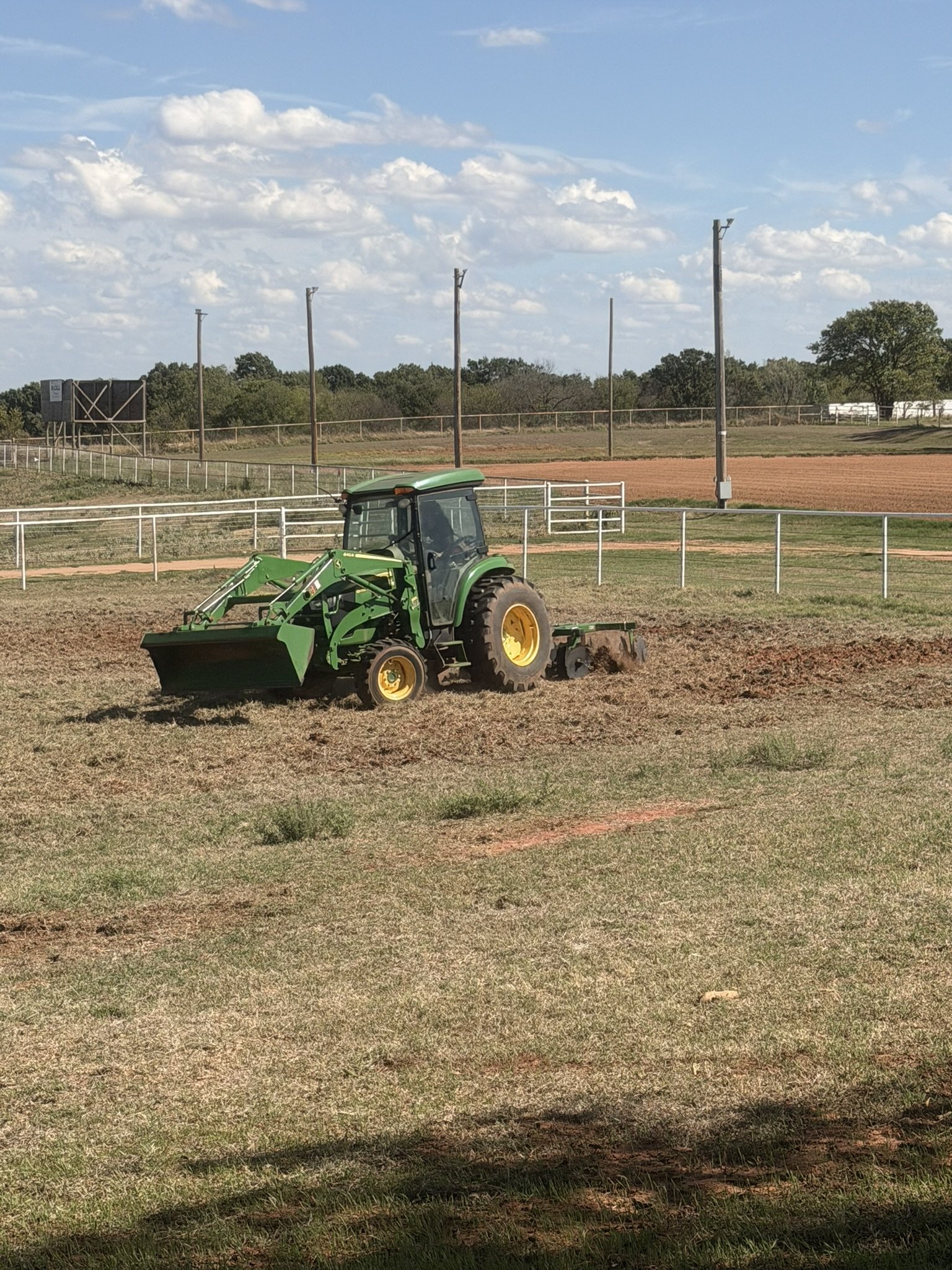
The strawberry area started as grass.
A lot of grass.
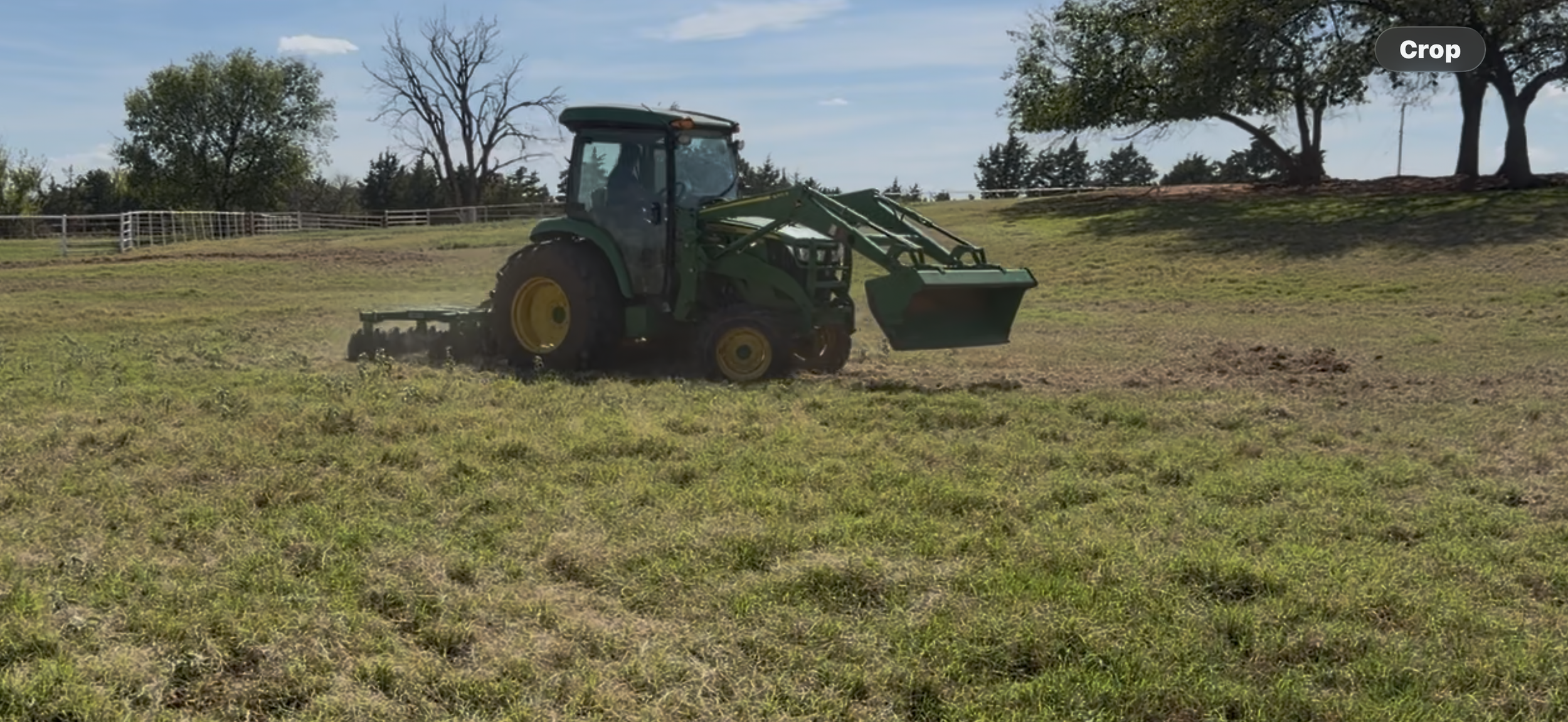
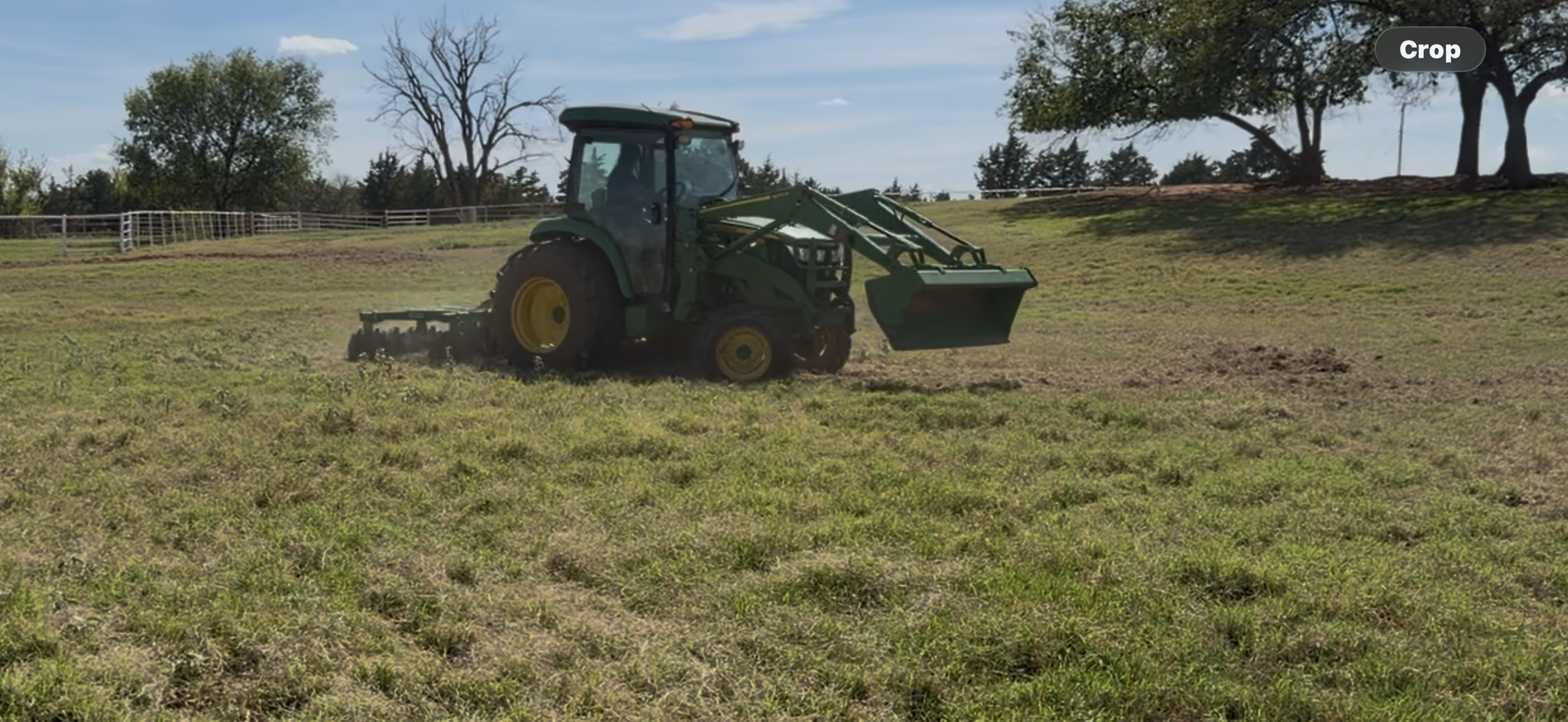
We did not want to deeply plow the field, so the first step was to use a disc harrow attachment behind the tractor.
The discs cut into the surface, broke up the grass, loosened the top layer of soil, and started preparing the ground for the beds.
This required some adjusting.
And by “adjusting,” we mean there is a photo of Daniela standing in the field with what looks very much like a crowbar trying to convince the disc to cooperate.
Farm equipment is wonderful.
Farm equipment also occasionally requires negotiation.
Once the disc had done its job, we followed with the arena drag we normally use for the horse arenas.
That pulled up more grass, worked the soil further, and helped smooth and level the field.
At this point, things were beginning to look promising.
Which is usually when we become overly confident.
Surely We Can Just Build the Beds by Hand
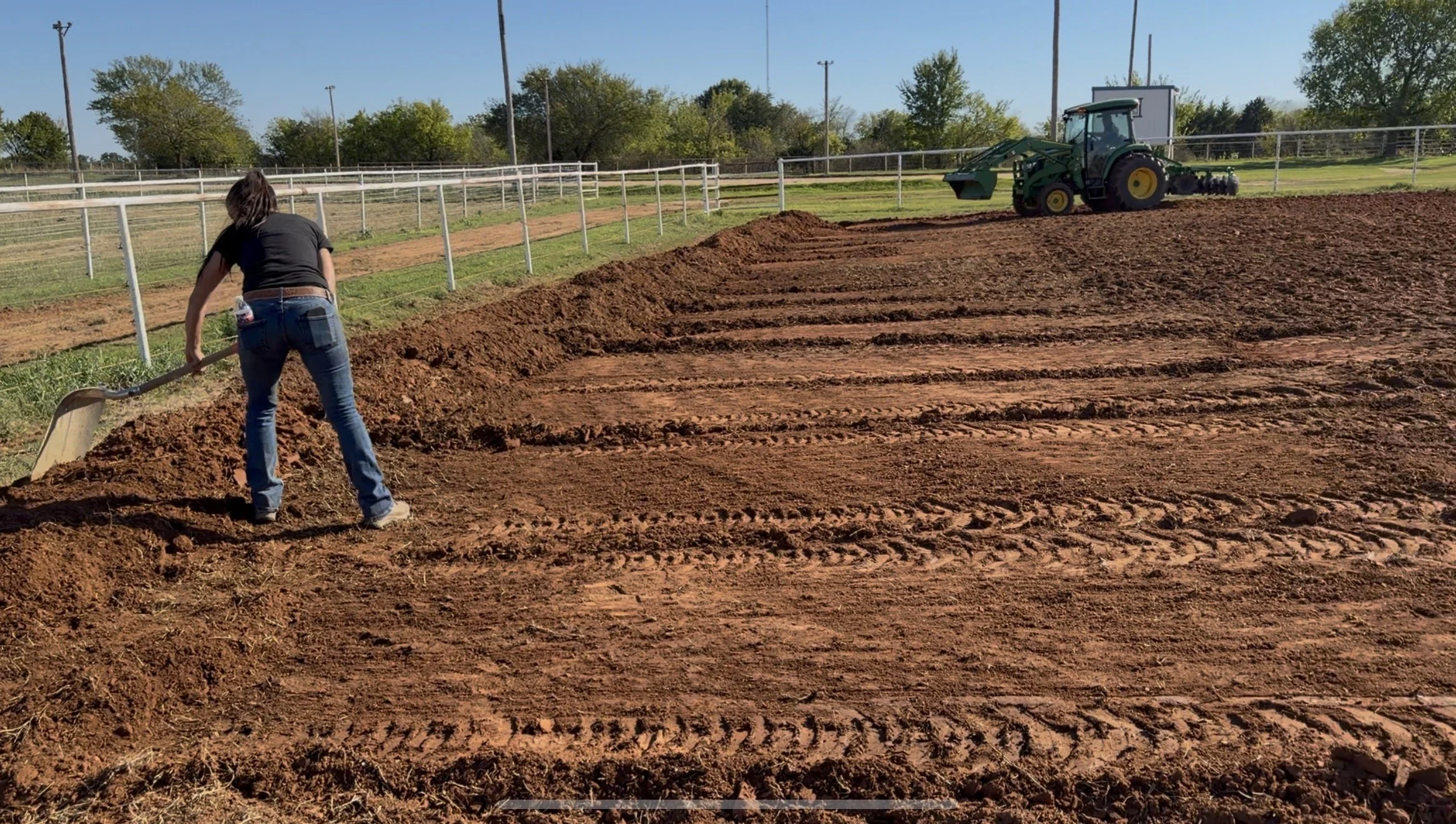
The plan called for five raised beds approximately 30 inches wide, with roughly three feet between each row.
Our first approach was very reasonable.
We decided to build them manually.
With shovels.
Five.
Hundred.
Feet.
Daniela was shaping the beds by hand while Phil moved dirt around, and for a while we were all apparently committed to proving that modern agricultural equipment was unnecessary.
We bent over.
We shoveled.
We shaped.
We reshaped.
We stared at the rows.
We moved more dirt.
And eventually the obvious question occurred to us:
Why are we doing this by hand when there is a tractor sitting right there?
This question would have been more useful approximately two hours earlier.
The Tractor Bucket Saves the Day
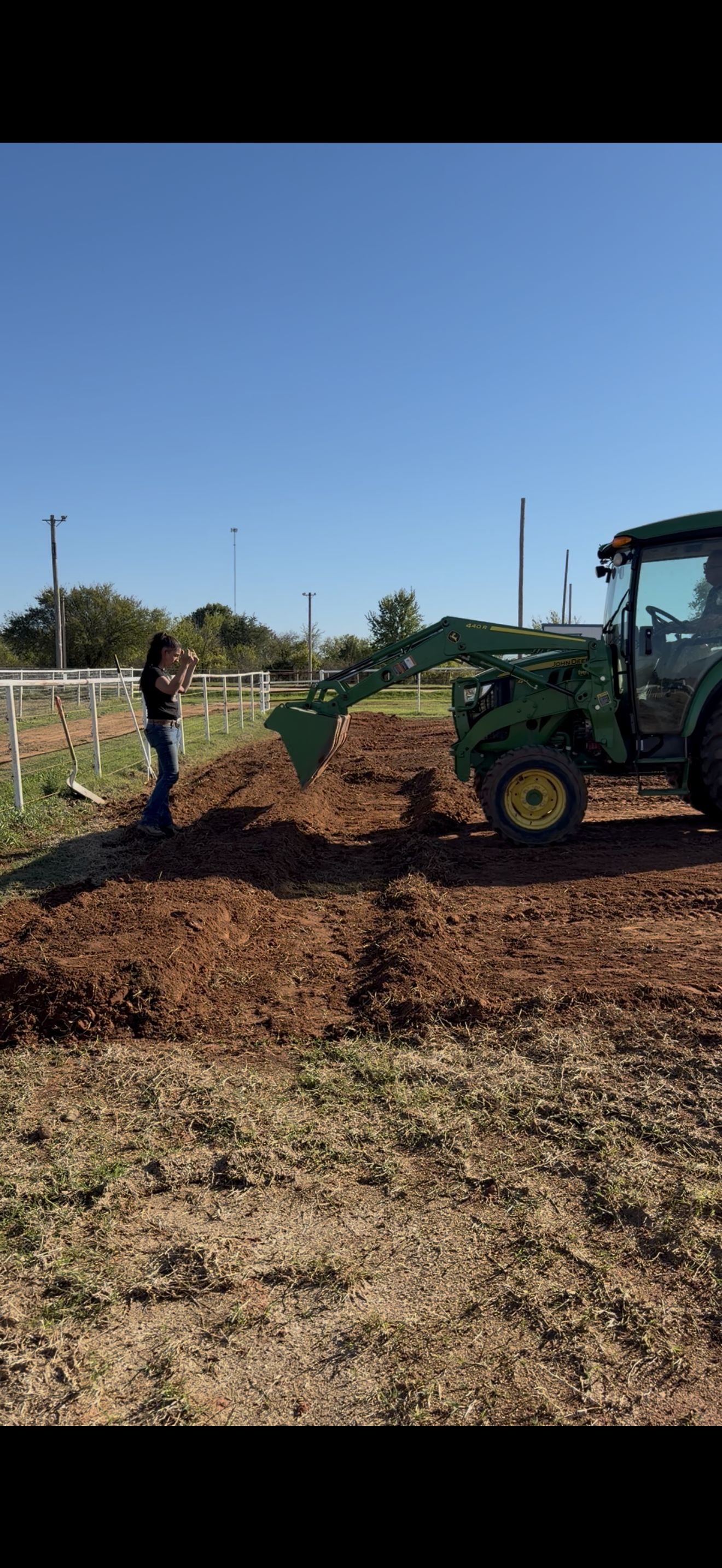
Once we stopped trying to recreate agricultural life from 1890, things improved dramatically.
Phil got into the tractor.
Daniela stood in the field directing traffic.
A little more dirt here.
Less there.
Wider.
Flatter.
Move over.
Back up.
Try again.
And suddenly the tractor bucket was doing in minutes what we had been attempting to accomplish manually.
Daniela still did some final shaping with a flat shovel, but the majority of the heavy work was now being done by the machine specifically designed to move dirt.
Revolutionary.
We also discovered that our supposedly 30-inch beds were not exactly 30 inches.
Some were probably closer to 36 to 40 inches wide.
At the time, this felt like a mistake.
Later, it turned out to be one of the luckiest mistakes of the entire project.
More on that shortly.
Then Came Irrigation
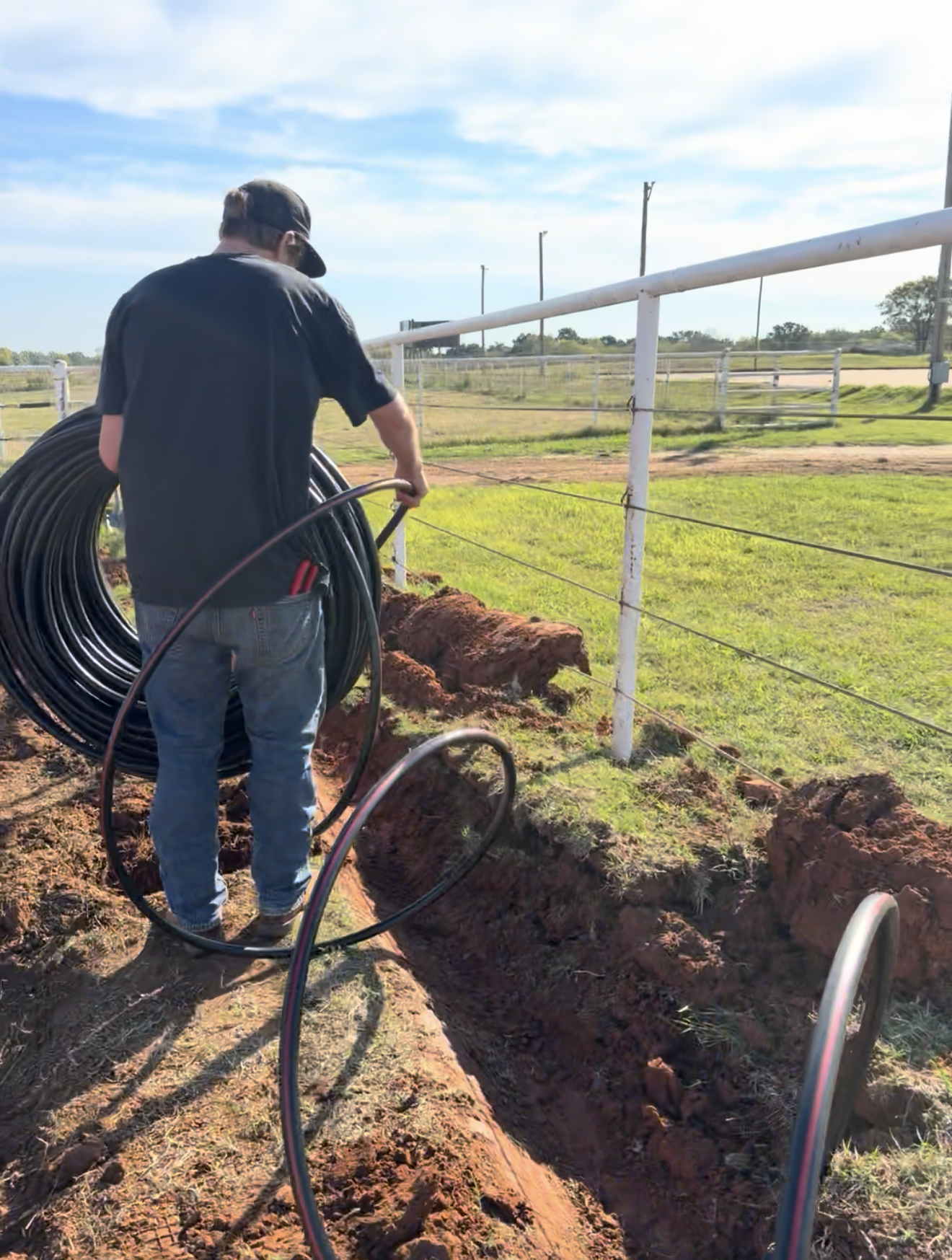
Once the beds were formed, we needed to install irrigation before covering everything with plastic mulch.
Our friend Taylor came out to help us plan and install the system.
Originally, we intended to use drip tape.
That was the plan.
And like many farm plans, it lasted right up until we tried to actually buy the materials.
We could not get the drip tape we wanted locally in time.
Normally, we might have waited.
Unfortunately, a large amount of rain was expected, and the strawberry plants needed to get into the ground before the weather changed.
So waiting was not really an option.
We switched to poly tubing instead.
The tubing was laid underneath where the plastic mulch would go, and we tested the system to make sure water was actually moving through the rows.
It worked.
Which briefly gave us the dangerous feeling that we had everything under control.
Then we started laying plastic.
Plastic Mulch Versus Oklahoma Wind
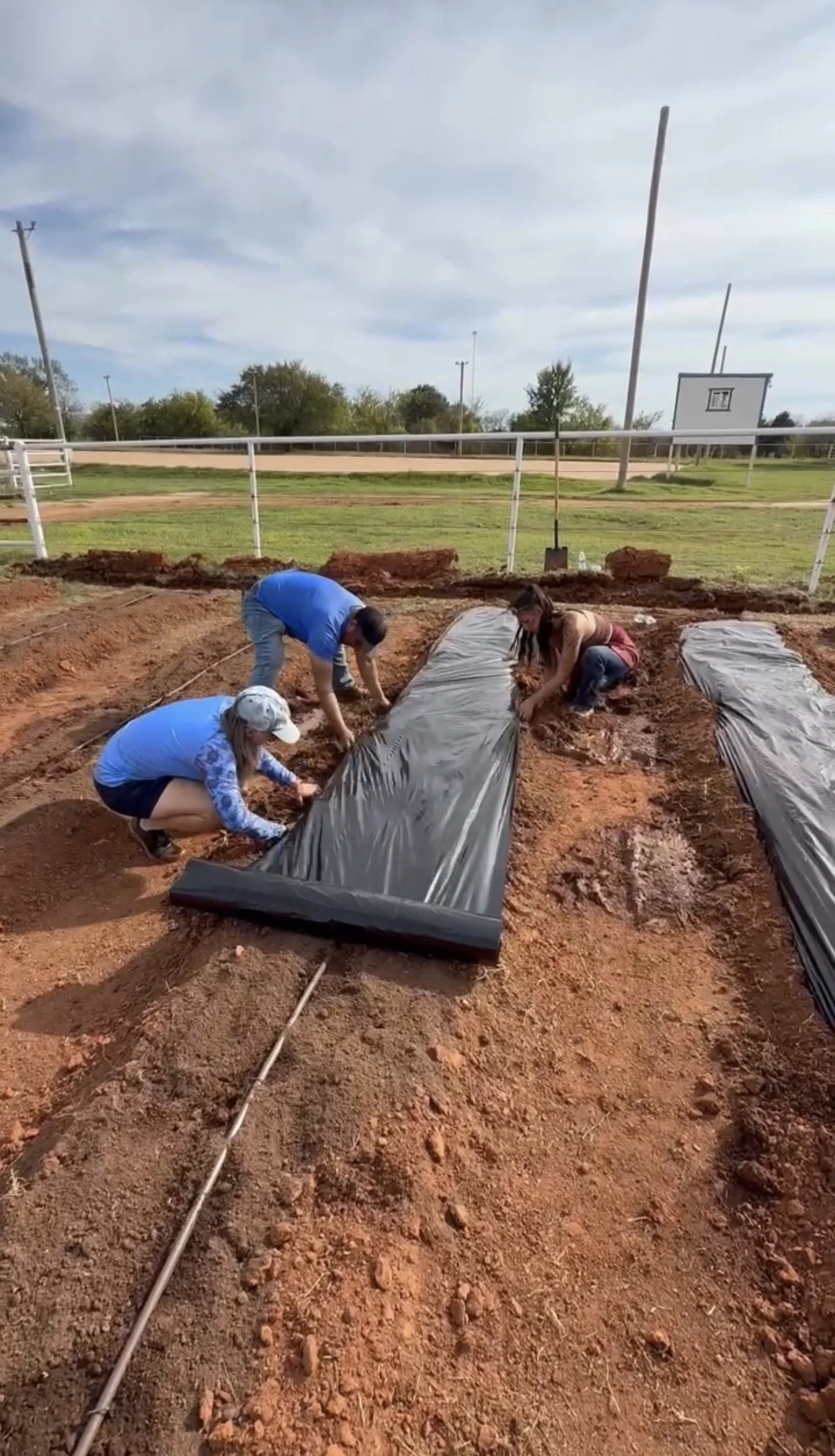
Each raised bed needed to be covered with black plastic mulch.
The idea is straightforward.
Stretch the plastic tightly over the bed.
Bury the edges.
Plant the strawberries through holes in the plastic.
Simple.
Except plastic mulch is essentially a giant 100-foot sail.
And we live in Oklahoma.
Four people would stretch and position the plastic while the wind attempted to relocate it to another county.
The plastic needed to be pulled as tightly as possible so it would sit firmly against the soil and not flap, shift, or collect water.
So we developed a system.
Pull.
Hold.
Tuck.
Bury.
Move forward.
Repeat.
Approximately forever.
The Part Where We Questioned All of Our Life Choices
This turned out to be the hardest physical part of the entire project.
The edges of the plastic had to be buried so they would stay secure.
We did not use equipment for this.
We did it by hand.
That meant pulling soil away from the sides of the raised beds, tucking the plastic down into the trench, pushing the soil back over it, and packing everything tightly enough that the Oklahoma wind would not immediately undo our work.
Over.
And over.
And over.
For 500 feet.
This was also the moment when our accidentally oversized strawberry beds suddenly became very useful.
Because the rows had ended up closer to 36 to 40 inches wide instead of exactly 30, we had enough loose soil along the edges to pull away, tuck the plastic, and then push back over the top.
What had looked like imperfect measuring became a surprisingly helpful design feature.
We are choosing to call that foresight.
Then It Got Muddy
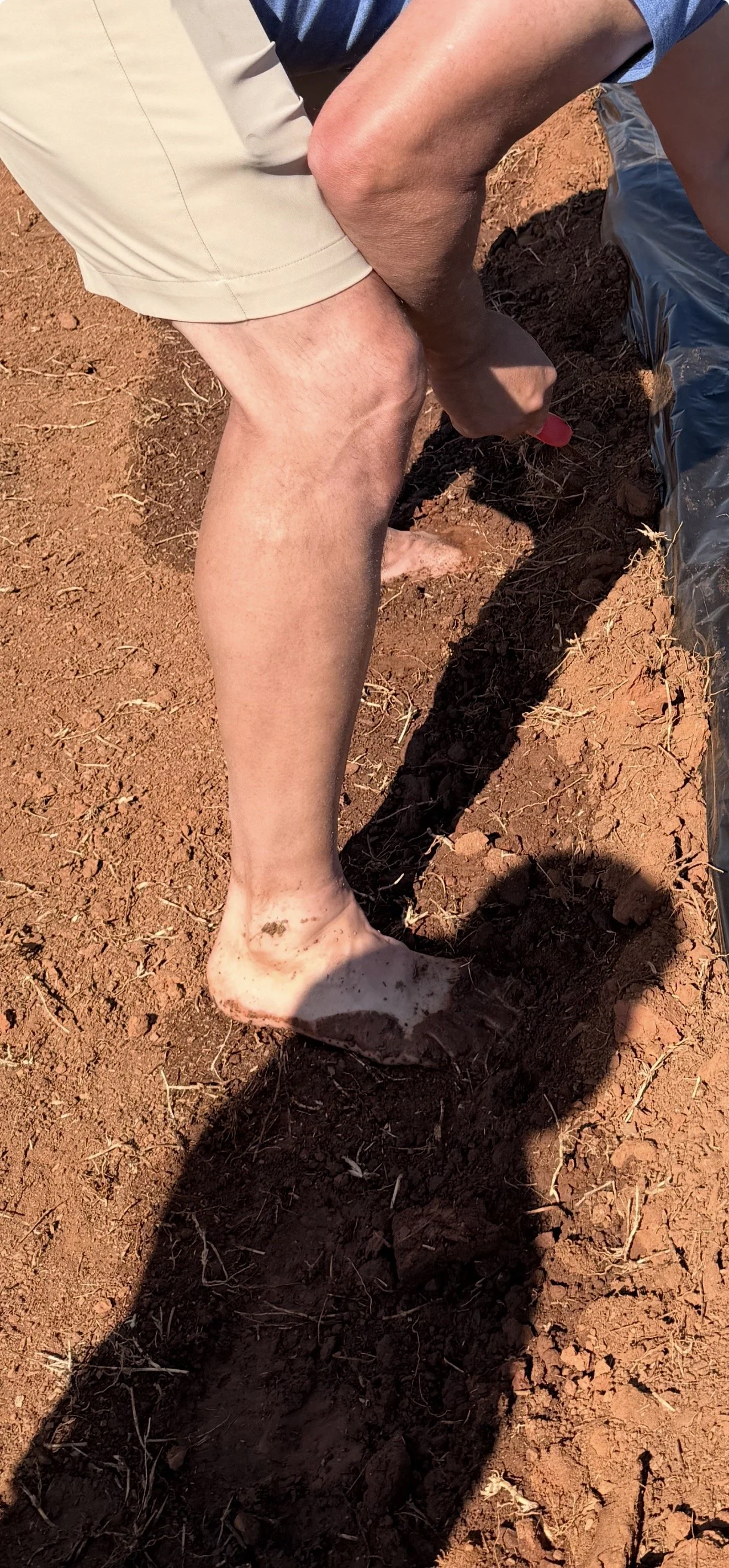
Once the irrigation was running, the field started getting wet.
Very wet.
And because we were working around newly formed beds, loose soil, irrigation lines, and freshly installed mulch, parts of the field quickly turned into mud.
There comes a point in every farm project when footwear becomes optional.
Several of us reached that point.
Shoes came off.
Bare feet went into the mud.
And we kept working.
This was when Arianna, observing the amount of direct contact we were having with wet soil, lovingly informed the family that we probably all needed to be dewormed afterward.
Thank you, Arianna.
Very comforting.
Finally: 900 Strawberry Plants
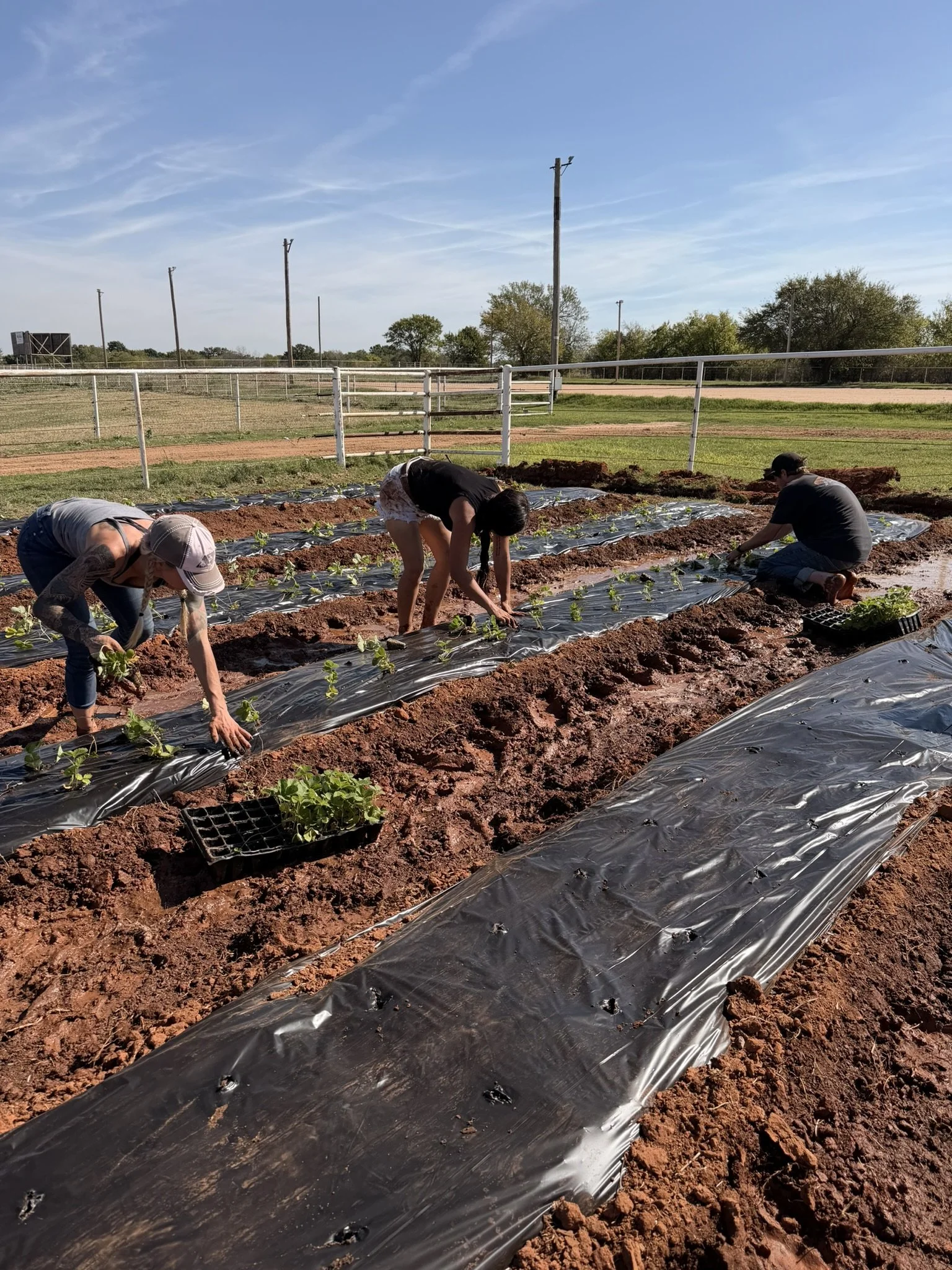
Once the field preparation, irrigation, and plastic mulch were finished, it was finally time for the part we had supposedly been doing all of this for:
Planting strawberries.
The whole family came together.
Daniela.
Kristina.
Arianna.
Philip.
Dimitri.
And Taylor.
Five rows.
100 feet each.
A total of 900 strawberry plants.
Plant by plant, we worked our way down the rows.
After days of dirt work, irrigation, plastic, wind, mud, and figuring things out as we went, seeing actual strawberry plants in the beds felt incredibly satisfying.
The field finally looked like a strawberry field.
Or at least the beginning of one.
We Even Have Room for More
We ended up with a little extra space at the end of one row.
We plan to use that area for additional plants grown from runners clipped from the strawberry plugs.
Which means our 900-plant strawberry field may not stay at 900 plants for very long.
Because apparently once you plant 900 strawberries, the obvious next step is more strawberries.
Meanwhile, the Cats Declined to Participate
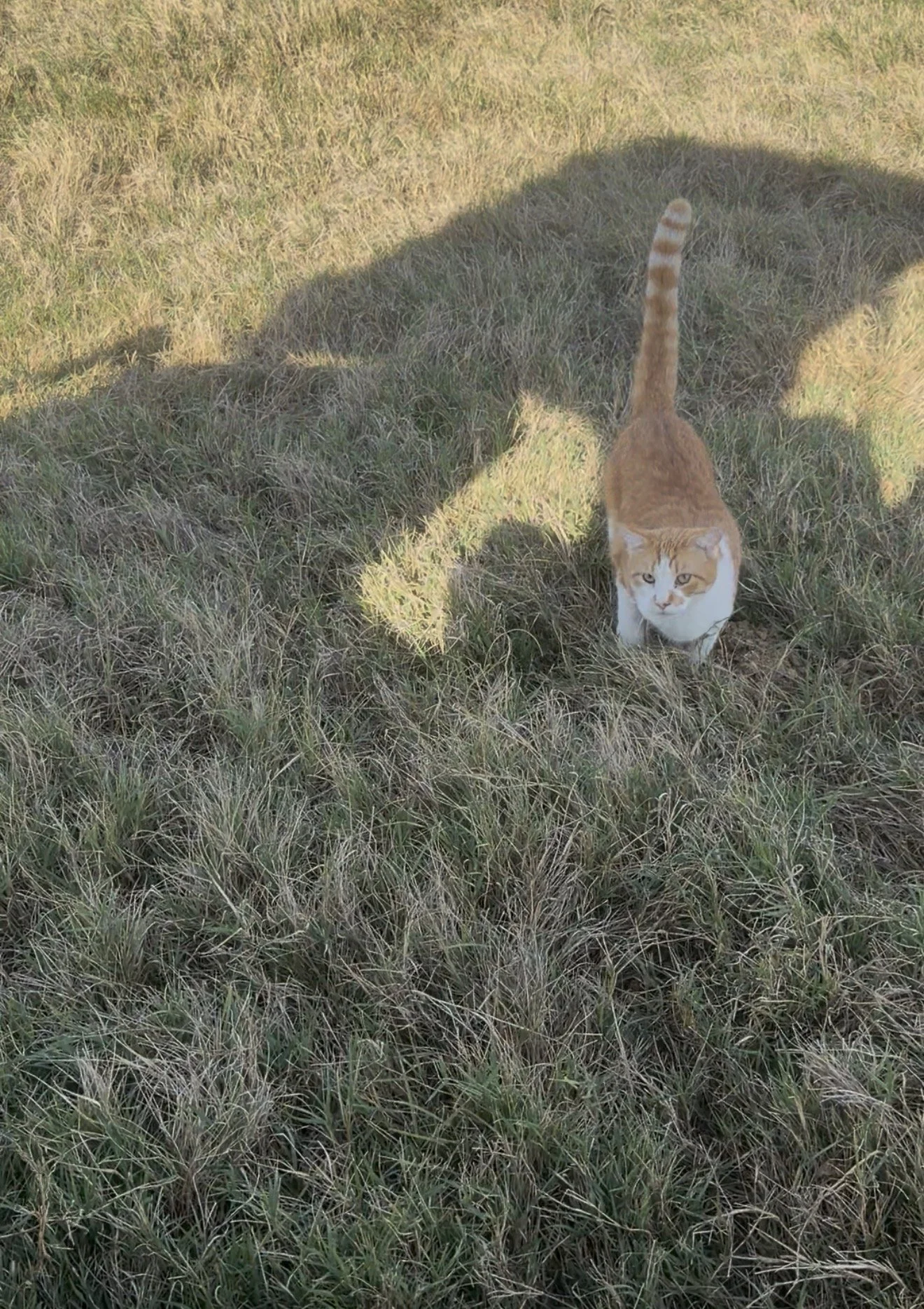
Anyone who followed our chicken-processing story may remember that Binx took his role as farm supervisor extremely seriously.
Not this time.
Binx runs the north side of the property near Daniela’s house and apparently decided the strawberry field was outside his jurisdiction.
Killer, who controls the south side of the property, was technically closer to the action.
She also declined.
Apparently strawberry planting did not meet either cat’s supervisory requirements.
So for once, we were unsupervised.
This may explain some things.
What We Learned From Building Our First Strawberry Field
We learned several useful things very quickly.
First, if there is a piece of equipment capable of doing the job, consider using it before spending several hours doing the same thing manually.
Second, Oklahoma wind and plastic mulch are natural enemies.
Third, irrigation should always be tested before everything is covered.
Fourth, beds that accidentally end up a little wider than planned may save you later.
And finally:
If six people spend enough time barefoot in a muddy strawberry field, somebody in the family will eventually suggest deworming everyone.
Apparently this is farm life now.
October 24, 2026: Planting Day
By Saturday, October 24, all 900 strawberry plants were officially in the ground.
Five rows.
100 feet each.
Irrigation underneath.
Plastic mulch secured.
Plants watered.
Mud everywhere.
Bodies exhausted.
Done.
And that last part felt very good.
A few days earlier, this was just a grassy field.
Then it became dirt.
Then raised beds.
Then irrigation lines.
Then plastic-covered rows.
And finally, a strawberry field.
Now comes the part we cannot control.
The weather.
Winter.
Rain.
Freezing temperatures.
Root development.
Plant survival.
And eventually, hopefully, flowers and strawberries.
If everything goes according to plan, these plants will establish through the winter and begin producing next spring.
Our goal is still the same:
Strawberries by May and our first Rein Maker Ranch Farmstead U-Pick event.
Of course, there are several months of Oklahoma weather standing between us and that goal.
So we will keep you posted.
Another Farmstead Milestone
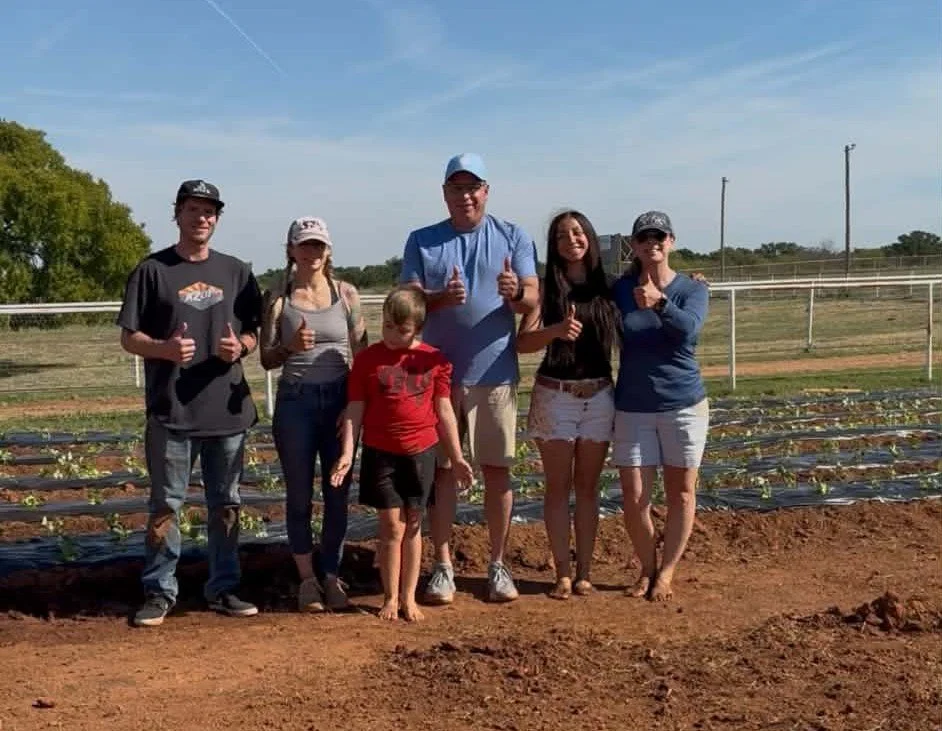
The strawberry field was probably one of the most physically demanding projects we have taken on so far.
It also taught us something we seem to learn repeatedly around here:
The first time you do something, you do not know what you do not know.
You research.
You plan.
You buy materials.
You think you understand the process.
Then you get into the field and discover that the tractor bucket would have saved you hours, your plastic mulch has become a kite, and half the family is barefoot in mud.
And somehow, you still finish.
That is becoming one of our favorite things about building Rein Maker Ranch Farmstead.
We are not waiting until we know exactly what we are doing.
We are learning by doing it.
Sometimes efficiently.
Sometimes the hard way.
Usually both.
Five rows. 500 feet of strawberry beds. 900 plants in the ground. One very muddy family. Zero interested cats.
And one more piece of Rein Maker Ranch Farmstead officially underway.
Watch the video of our journey here: From Reining Horse Pasture to 900 Strawberry Plants
October on the Farmstead: Garlic, Strawberries, and Questionable Timing
October at Rein Maker Ranch Farmstead means 400 garlic cloves in the ground, 500 feet of strawberry beds underway, and a very intentional decision to plant strawberries before winter. We’re preparing raised beds with compost, drip irrigation, and plastic mulch while following Oklahoma State University Extension guidance on fall strawberry planting—and hoping Oklahoma weather cooperates long enough to get it all done.
October on the farmstead has officially become the month where everything apparently needs to happen at once.
Because naturally, after finishing one project, the logical next step is to immediately start three more.
In May, we harvested our first garlic.
In October, part of that same garlic went right back into the ground.
And while most people are thinking about pumpkins, sweaters, and putting their gardens to bed for the year, we are getting ready to plant strawberries.
Yes.
Strawberries. In October.
Intentionally.
We checked.
From 100 Garlic Heads to 400 Cloves in the Ground
Earlier this year, we harvested approximately 100 heads of garlic.
Some of it was processed and kept for our own kitchen.
The rest was dried and saved specifically for replanting.
That gave us roughly 400 cloves to put back into the ground this October.
This is one of the parts of farmstead life we are starting to really love.
A harvest is not always the end.
Sometimes it is dinner.
Sometimes it is pantry storage.
Sometimes it is next year’s crop.
And sometimes it is all three.
Which feels much more satisfying than buying garlic at the grocery store, using three cloves, forgetting the rest in a drawer, and rediscovering it six weeks later with enough green shoots to start its own farm.
Progress.
And Now We’re Planting Strawberries
The next big October project is much larger.
We are planting strawberries.
A lot of strawberries.
And yes, we know October sounds like a strange time to do that.
That was our first reaction too.
But this one is actually intentional.
Oklahoma State University Extension notes that fall-planted strawberries in suitable parts of Oklahoma can establish a more extensive root system before spring, which can help the plants come into the growing season stronger.
So instead of asking the plants to immediately produce leaves, flowers, and fruit, we are giving them time to concentrate on roots first.
Which sounds very logical.
Until you remember that they will be spending winter outside.
In Oklahoma.
The Slight Problem With Our Brilliant Plan
The Farmers’ Almanac is forecasting a wetter, stormier winter for this part of the country, with the potential for periods of sleet, freezing rain, and wet snow.
So naturally, this is the year we decided to try fall-planted strawberries.
Of course it is.
Long-range forecasts are not guarantees, and we are not planning the entire crop around an almanac prediction.
But we are paying attention.
Too little moisture is a problem.
Too much moisture is a problem.
A hard freeze is a problem.
Apparently strawberries would prefer winter to happen, but politely.
We will see what Oklahoma decides.
Five Raised Beds, 100 Feet Each
Yesterday, we started the dirt work for the strawberry field.
Not plowing.
We are shaping the ground into five raised beds, each approximately 100 feet long.
That is 500 feet of strawberry beds.
Seeing the first beds take shape was one of those moments when the project suddenly stopped being theoretical.
It is one thing to say:
“We’re going to plant strawberries.”
It is another thing to look at 500 feet of dirt and realize:
“Oh. We are really going to plant strawberries.”
The raised beds should help with drainage and give us a more controlled planting area.
They will also make the field look much more organized than it currently does, which is encouraging because right now it looks mostly like a large amount of dirt and optimism.
Our Compost Was Not Ready
One part of this project did not go exactly according to plan.
We have been building our own compost, and eventually we want more of our soil amendments to come directly from the farmstead.
But compost does not care about deadlines.
Ours is not ready yet.
The strawberries, however, are.
So we purchased compost from another source to prepare the beds.
This was another good reminder that farmstead life is not about pretending every system is already perfect.
Sometimes your compost is ready.
Sometimes it is not.
Sometimes you buy compost and tell your own compost pile to please pick up the pace.
We are learning.
Drip Lines Under the Plastic
Once the beds are shaped and amended, we will install drip irrigation underneath black polyethylene mulch.
The plastic will cover the raised beds, and the strawberry plants will grow through openings in the mulch.
The drip lines underneath will deliver water directly into the soil around the roots.
OSU recommends drip-style irrigation for strawberries because it can conserve water and help reduce disease issues associated with constantly wet foliage.
The plastic mulch will also help suppress weeds and keep the berries cleaner.
Again, this sounds very simple when written down.
In practice, the list looks more like this:
Shape beds.
Add compost.
Install drip lines.
Lay plastic.
Secure plastic.
Make planting holes.
Plant strawberries.
Check irrigation.
Fix whatever we did wrong.
Check weather.
Recheck weather.
Stare suspiciously at the weather app.
Then plant faster.
Because Apparently We Have No Time
That may be the biggest theme of October.
Timing.
Garlic has a planting window.
Strawberries have a planting window.
Compost has its own timeline and apparently did not receive the memo.
Weather has absolutely no interest in our schedule.
And once the strawberry plants are ready to go in the ground, the entire system needs to come together quickly.
This is where farmstead planning on paper and actual farmstead work become two very different things.
On paper:
Plant strawberries in October.
Done.
In reality:
Prepare 500 feet of raised beds.
Get compost.
Move compost.
Shape beds.
Install irrigation.
Buy plastic mulch.
Lay plastic mulch.
Make holes.
Plant hundreds of strawberries.
Check the forecast.
Panic briefly.
Continue planting.
Much more accurate.
If This Works, May Should Be Very Fun
If everything goes the way we hope, the strawberry plants will spend winter establishing themselves and should be ready to produce next spring.
Our goal is to have strawberries around May, which lines up with normal spring strawberry harvest timing in Oklahoma.
And this crop has a bigger purpose.
We are planning our first Rein Maker Ranch Farmstead U-Pick strawberry event.
The idea is simple.
Instead of harvesting everything ourselves, families will be able to come to the farm, walk the rows, and pick strawberries themselves.
At least, that is the plan.
Between now and May, there are only a few minor details to work out:
Winter.
Rain.
Freezing temperatures.
Plant survival.
Flowers.
Pollination.
Birds.
Rabbits.
Deer.
Possibly children eating strawberries faster than anyone can weigh them.
Nothing major.
We’re Building This While We Learn
One of the things we said when we started the Rein Maker Journal was that we were not going to wait until the farmstead was finished and then tell the story as though everything went perfectly.
Because that would be fiction.
We want to document this while it is actually happening.
The successes.
The mistakes.
The things we researched.
The things we figured out halfway through.
And the moments when we stand in the middle of a field and wonder whose idea this was.
October feels like a very good example.
Garlic harvested in May is now becoming next year’s garlic crop.
Our compost is still cooking, so purchased compost is filling the gap.
Five 100-foot strawberry beds are beginning to take shape.
Drip lines and plastic mulch are next.
And hundreds of strawberry plants are about to spend an Oklahoma winter outside because, according to the research, that is exactly where we want them.
Assuming Oklahoma behaves itself.
Which feels optimistic.
If everything goes well, we will be standing in those same rows next May surrounded by strawberries.
And hopefully, some of you will be standing there with us.
October on the farmstead: 400 garlic cloves in the ground, 500 feet of strawberry beds underway, winter coming fast, and another very reasonable project that somehow turned into a race against the weather.
That feels about right.
Nothing Wasted: Bones, Feet, Heads and Blood
After raising and processing our first 22 Delaware chickens, we learned that “nothing wasted” means a lot more when you’ve invested your own time, money, care, and work into the food. From carcasses turned into homemade bone broth to chicken feet for dog treats and blood for the compost, this was our first real lesson in whole-animal use—and in how farmstead life can completely change the way you think about waste.
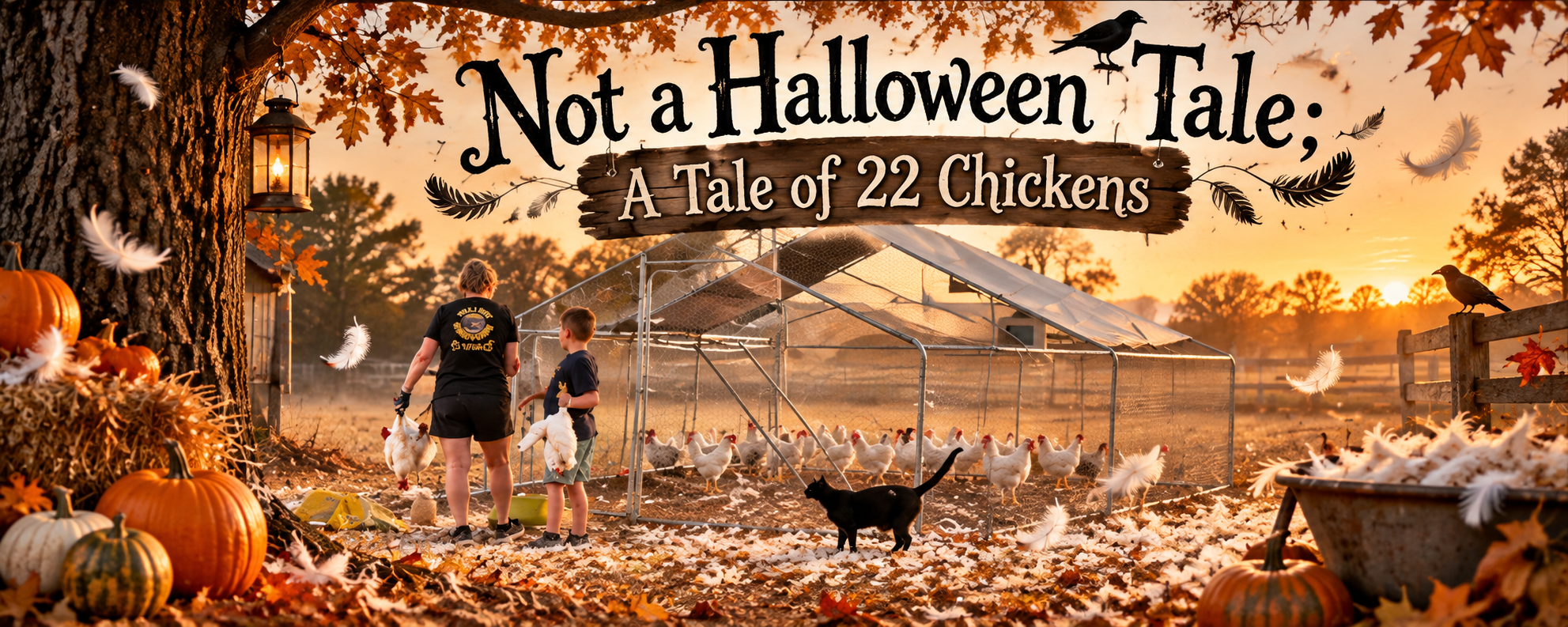
Not a Halloween Tale; A Tale of 22 Chickens
The very first family journey on our farmstead wasn’t elaborate, expensive, or glamorous.
It was, however, our first real milestone toward what we hope Rein Maker Ranch Farmstead will become.
After processing our first flock of 22 Delaware chickens, we were left with something we had never really thought much about before:
A lot of chicken parts.
Not just meat.
Bones….
Feet…
Heads..
Blood.
And a very clear reminder that if you are going to raise your own food, you suddenly become much more aware of what normally gets discarded long before anything reaches a grocery store.
“Nothing wasted” is one of those phrases you hear often in sustainability circles and the farmstead world.
It sounds nice.
It sounds responsible.
It also sounds slightly different when you are standing there looking at 22 chicken heads, 44 feet, a pile of carcasses, and buckets from processing day.
When we say nothing was wasted, we mean it.
Well… almost.
The feathers are another story.
We’ll get to those.
22 Heads
Let’s start with the least glamorous category.
The heads.
Twenty-two of them.
There is really no elegant way to say that.
This was probably the moment when our “farm-to-table” lifestyle became less Pinterest and a little more National Geographic.
But once you start thinking in terms of using the whole animal, even the parts that seem unusual become part of the conversation.
For us, the bigger lesson was simple:
Raising food yourself changes what you consider waste.
Things that would normally be thrown away suddenly make you stop and think.
Can we use this? Should we save this? Is there a purpose for this?
Sometimes the answer is yes.
Sometimes the answer is, “We need to look that up.”
And sometimes the answer is still, “Nope. That one is going away.”
Farmstead life is nothing if not educational.
44 Chicken Feet
The feet had a completely different destination.
All 44 chicken feet were saved and turned into dog treats.
This was another one of those things that probably would have seemed strange to us before we started raising our own food, but once you begin thinking in terms of whole-animal use, it starts to make sense.
Instead of throwing them away, we cleaned and prepared them for the dogs.
Apparently, one chicken’s leftover is another dog’s jackpot.
That was one more part of the bird that did not go to waste and one more reminder that “usable” does not always mean “for us.”
22 Carcasses
This part was much more familiar.
Once the usable meat was removed, we had the carcasses left behind.
And this is where Daniela took over.
Instead of treating the bones as leftovers, she turned them into something we now expect will become a regular staple in our kitchen:
homemade chicken bone broth.
For her first batch, Daniela used five chicken carcasses along with celery, carrots, onions, garlic, whole black peppercorns, and water.
Everything simmered low and slow for hours until the broth became rich, flavorful, and full-bodied.
Then came another new farmstead skill:
pressure canning.
There were a few lessons along the way, including some siphoning with the earlier jars, but eventually Daniela had five beautiful jars come out of the canner without losing a drop.
There may or may not have been an unreasonable amount of excitement over those five jars.
If you have ever learned pressure canning, you probably understand.
One of the best surprises came when a refrigerated jar of broth turned into a thick gel.
That was when we really understood just how different homemade broth made from our own chickens could be.
Suddenly, bones that might once have gone straight into the trash had become jars of broth for soups, stews, sauces, gravy, rice, and future family meals.
And apparently we are now the kind of family that gets excited about gelatinous chicken broth.
Farmstead life sneaks up on you.
Want to Make It Yourself?
Daniela put together the full step-by-step recipe, including the ingredients, simmering process, what she learned during her first batches, and important pressure-canning notes.
→ Read Daniela’s Homemade Chicken Bone Broth Recipe
And Then There Was the Blood
The blood was not discarded either.
We used it in our compost.
That was probably one of the clearest examples of what “nothing wasted” started to mean for us in practice.
Something that could easily have been treated as waste became part of the cycle back into the farmstead.
The chickens helped feed our family.
The bones became broth.
The feet became dog treats.
And the blood went into the compost that will eventually help feed the soil.
That is the kind of loop we want to build more of here.
Not because we are trying to be perfect, but because we want to become more intentional about using what we have.
Why Waste Suddenly Feels Different
One thing we did not expect was how differently we would feel about waste once we had raised the chickens ourselves.
When we bought chicken from the grocery store, it was easy to separate the food from everything that happened before it reached us.
If there was meat left on a carcass, bones we did not use, or something sitting too long in the refrigerator, throwing it away was easy.
We had paid for chicken.
We had not spent weeks feeding it.
We had not carried water to it.
We had not checked on it every day.
We had not watched it grow.
We had not invested our time, money, work, and care into raising it.
And we certainly had not stood together as a family and processed it ourselves.
That changes things.
When you have personally invested that much into producing your food, throwing part of it away suddenly feels very different.
The bones are no longer just bones.
The feet are not simply scraps.
Even the blood makes you stop and ask whether there is somewhere useful for it to go.
There is a sense of responsibility that comes with knowing exactly what went into putting that food on the table.
And we realized that we had become accustomed to waste too.
Food has become incredibly convenient in America.
Most of us can walk into a grocery store, pick up a neatly packaged tray of chicken, take it home, and never think much about the animal, the feed, the labor, the processing, or all the resources that came before that package.
That convenience can make waste easy.
We were guilty of it too.
Until now.
Raising these chickens did not suddenly make us perfect at sustainability, and we do not expect that we will never waste food again.
But it did make us more aware of the value of what we have.
After putting weeks of time, care, money, work, and—yes—love into raising an animal, you naturally want to honor that investment by using as much of it as you reasonably can.
For us, that may end up being one of the most important lessons our first 22 chickens taught us.
Not simply how to raise chicken.
Not simply how to process it.
But how easy it is to undervalue food when you never have to see what it takes to produce it.
And About Those Feathers...
We said almost nothing was wasted.
Almost.
The feathers were the exception.
At least for now.
After processing 22 chickens, there were a lot of them.
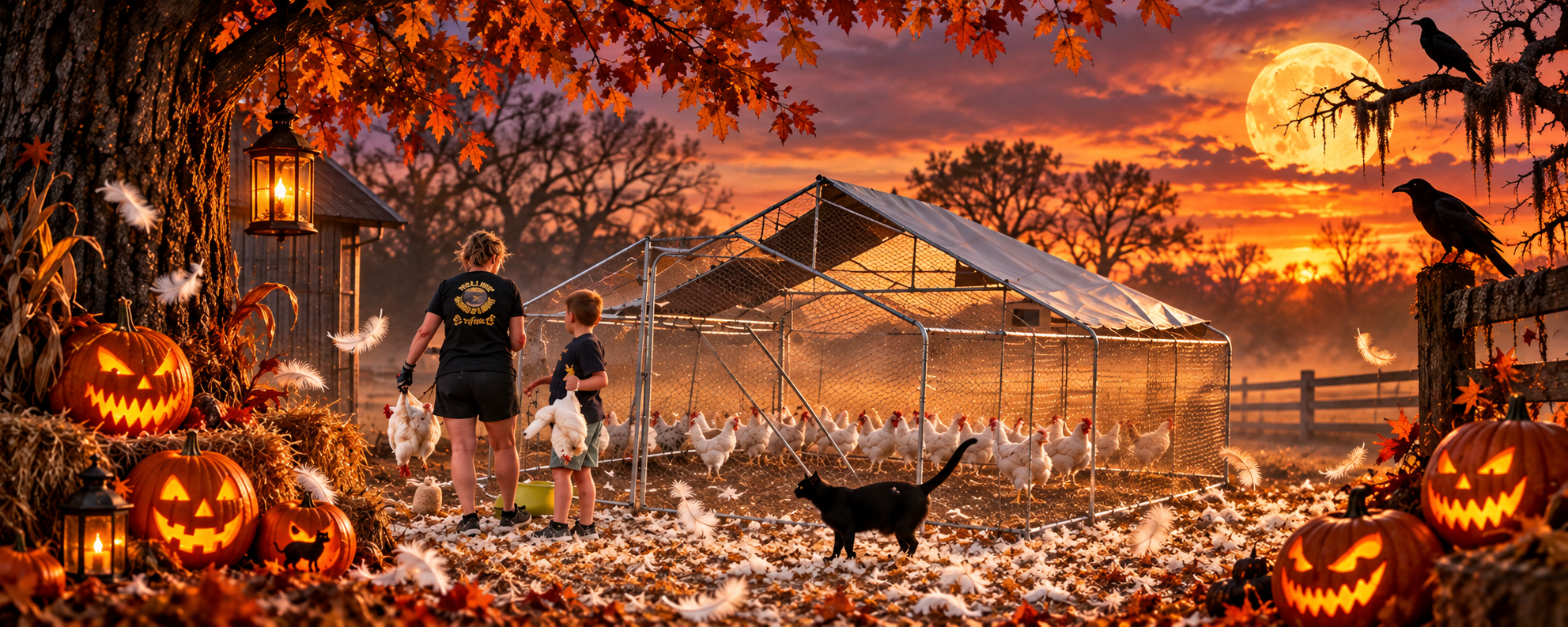
Enough that, for a brief moment, the scene looked less like a farmstead project and more like the aftermath of a very unfortunate Halloween ritual.
If someone had wandered onto the property at exactly the wrong moment, we probably would have had some explaining to do.
The feathers did not make it into broth.
They did not become dog treats.
They did not go into jars.
And unlike the blood, they were not part of our compost plan.
So for now, the feathers remain the one mysterious loose end in our “nothing wasted” experiment.
Perhaps by the next flock we will have figured out a practical use for them.
Or perhaps they will continue to be the slightly spooky evidence left behind after processing day.
Either way, every good farm story needs a little mystery.
Almost Nothing Wasted
By the time we were finished, those 22 chickens had provided far more than just meat for the freezer.
They gave us:
Chicken for family meals
Bones and carcasses for homemade broth
Chicken feet for dog treats
Blood for the compost
New pressure-canning experience
A better understanding of whole-animal use
Less waste overall
A pantry full of homemade broth
And a few more skills we did not have before
The feathers were basically the only part that did not find a second life this time.
We will call that progress.
This Is the Part of Farmstead Life We Love
The first chicken-processing day taught us how to turn a flock into food.
What happened afterward taught us something just as important:
There is a lot more value in an animal than the cuts of meat we are accustomed to seeing in the grocery store.
When you raise the animal yourself, you naturally want to make the most of what it provided.
And that creates a different level of respect for the food.
“Nothing wasted” does not mean we will always use every single thing perfectly.
It means we are learning to look at the entire process differently.
To ask more questions.
To use more.
To waste less.
To learn skills we did not have before.
And occasionally to stand in the kitchen admiring a jar of gelatinous chicken broth like it is a major life accomplishment.
Because apparently that is who we are now.
And we are perfectly fine with it.
Twenty-two chickens. Forty-four dog treats in the making. Twenty-two carcasses for broth. Blood for the compost. One suspiciously large pile of feathers. And one more step toward becoming the farmstead we are trying to build.
Our First Chicken Processing Day: Raising Delaware Chickens for Meat at Rein Maker Ranch Farmstead
We raised 22 Delaware chickens at Rein Maker Ranch Farmstead and recently completed our first family processing day from start to finish. From an 8-year-old chicken masseuse to a very interested farm cat, it was a real, hands-on lesson in farm-to-table living—and the beginning of how we plan to raise chicken for our family and future farm store.
22 Delaware chickens, five family members, an 8-year-old chicken masseuse, and one extremely interested farm cat.
By Kristina Picciotti
Rein Maker Ranch Farmstead | Purcell, Oklahoma
There are certain moments when building a farmstead stops feeling like a plan and starts feeling very real.
Processing our first flock of chickens was one of those moments.
We started with 22 Delaware chickens at Rein Maker Ranch Farmstead. Our original plan was to keep roughly half of the hens for eggs and process the others for meat.
But farm plans have a way of changing.
As winter approached, we reconsidered the timing. With shorter daylight hours and colder weather coming, we knew egg production would naturally slow significantly, and these young hens might produce little or no eggs for part of the winter. We decided it made more sense for this first flock to become food for our family.
So all 22 Delawares became our first home-raised chickens for the freezer.
And suddenly everyone had a job.
Our First Flock at a Glance
We raised 22 Delaware chickens as our first meat flock. Our family processed them together using poultry processing cones, a scalder, a mechanical chicken plucker, processing tables, and an ice-water chilling setup.
The Delawares were smaller than the commercial meat chickens most people are used to, but the meat turned out to be exceptionally tender, juicy, and flavorful.
Our next flock will be 40 Cornish Cross chickens, which are bred specifically for meat and should produce larger birds in a shorter amount of time.
But before we get to that, here is how our very first processing day actually went.
No Chopping Block Required
When most people picture processing chickens, they probably imagine an old-fashioned chopping block.
Thankfully, poultry-processing equipment has come a long way.
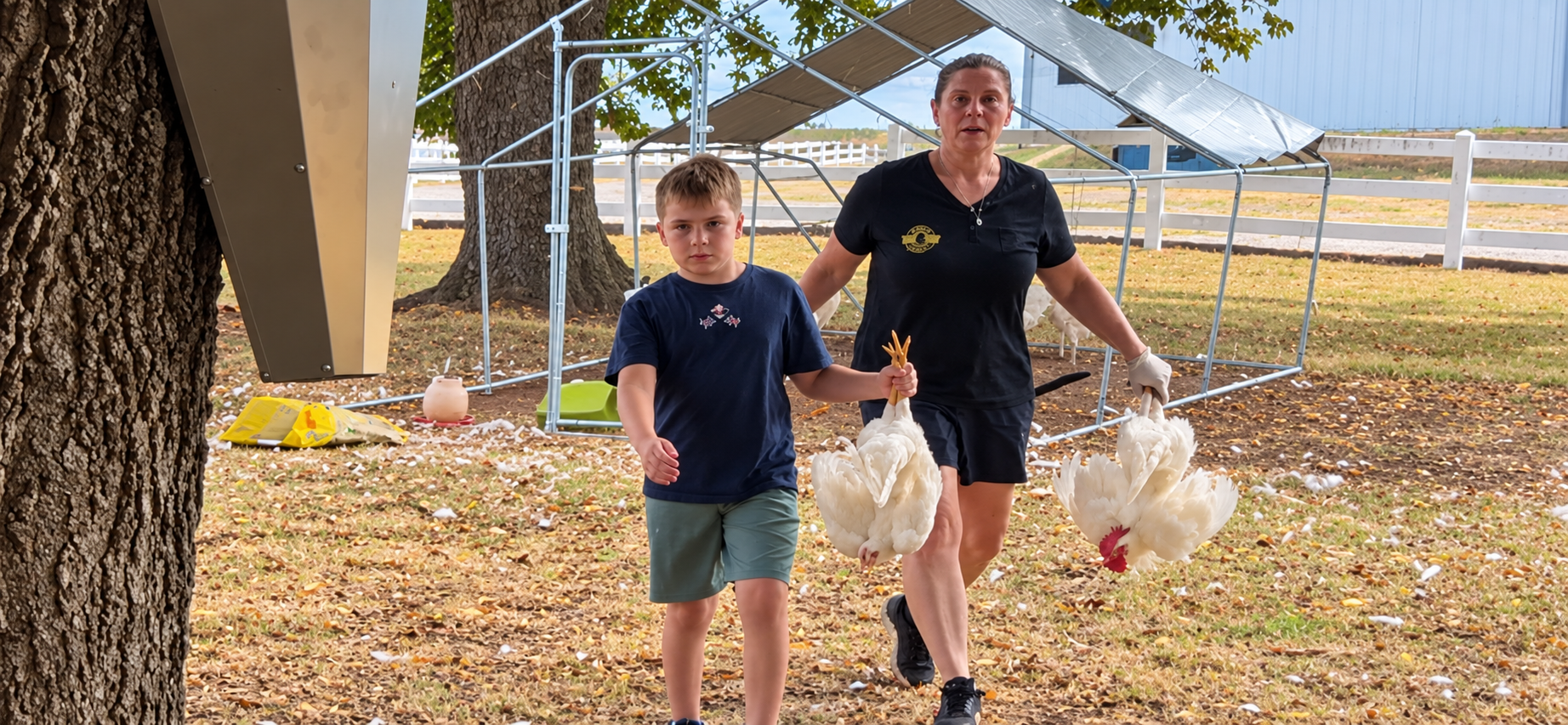
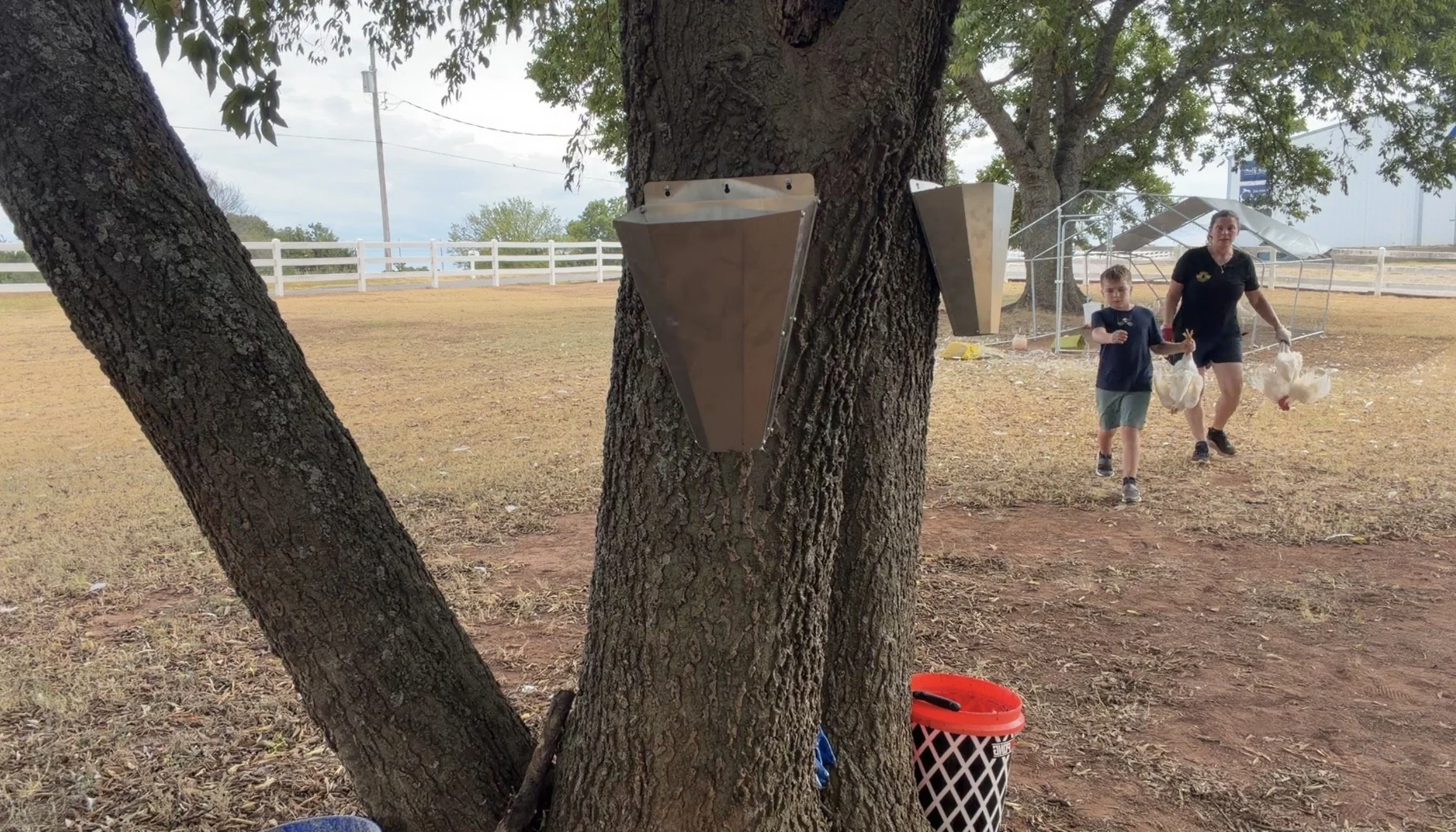
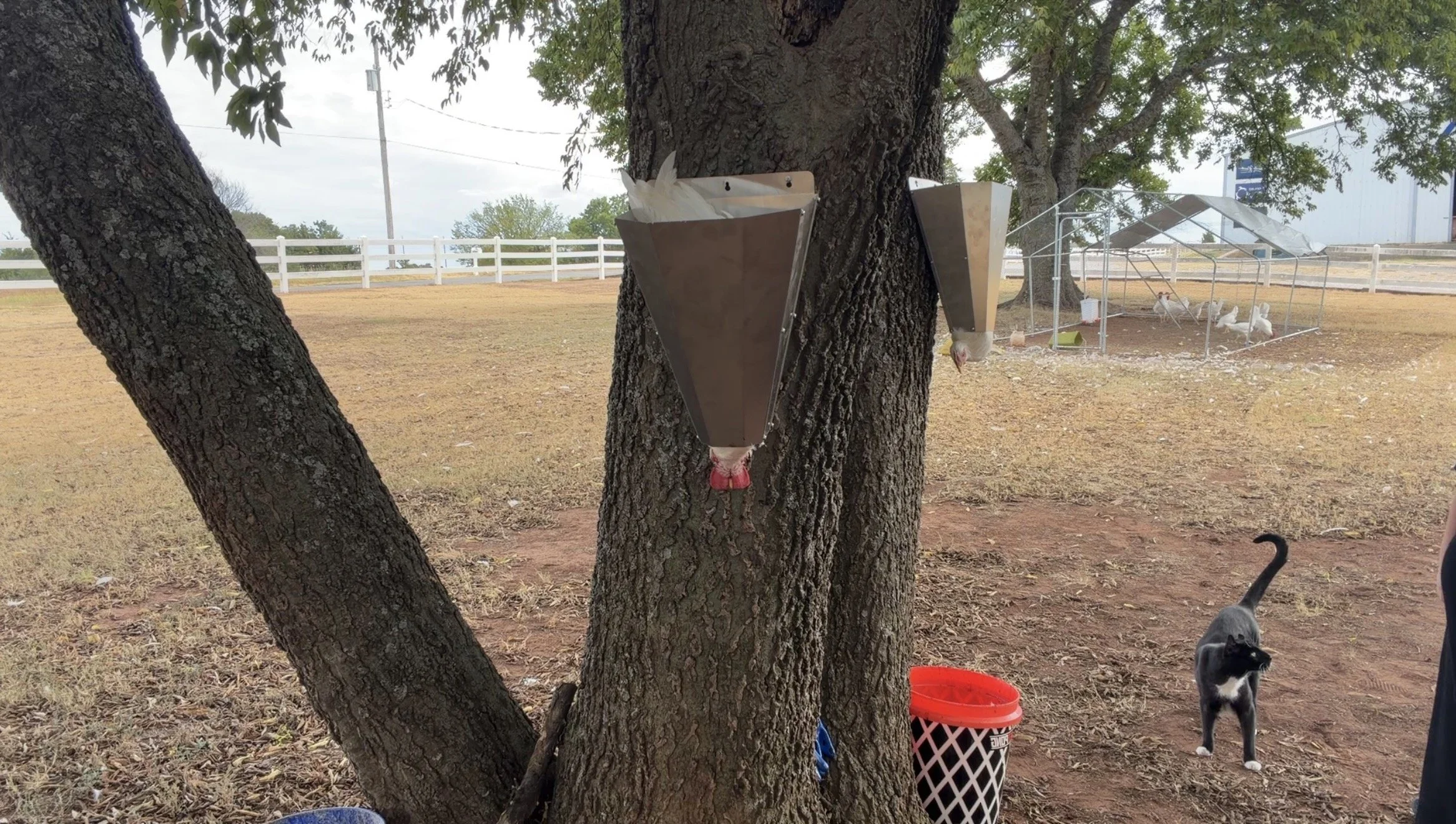
We purchased processing cones, which we mounted securely to one of the large trees on the farm. The chickens are placed head-down inside the cones, which helps keep them contained and makes the process easier to manage.
Seeing stainless-steel poultry cones mounted to a tree was also one of those little moments when we realized that Rein Maker Ranch had officially crossed over into full farmstead territory.
Kristina was responsible for dispatching the chickens.
This was probably the least-requested job of the day.
It is one thing to say you want to raise your own food. It is another thing to accept responsibility for every part of the process, including the part that is not particularly comfortable.
We wanted the birds handled calmly and respectfully, and that meant taking responsibility for the entire process from beginning to end.
Dimitri’s First Farm-to-Table Experience
One of the most memorable parts of the day was watching 8-year-old Dimitri experience all of this for the first time.
He had never seen chickens processed before.
Dimitri spent much of his early childhood near the beach in Florida, so standing beside a tree in Oklahoma while the family processed chickens was a very different kind of day for him.
He is also a genuine animal lover, so we were curious about how he would respond.
He surprised all of us.
He was calm, curious, and incredibly level-headed about the entire process.
Dimitri understood why we were doing it. He understood the idea of farm-to-table food and that these chickens had been raised with care to become food for our family.
But understanding that did not make him any less compassionate toward them.
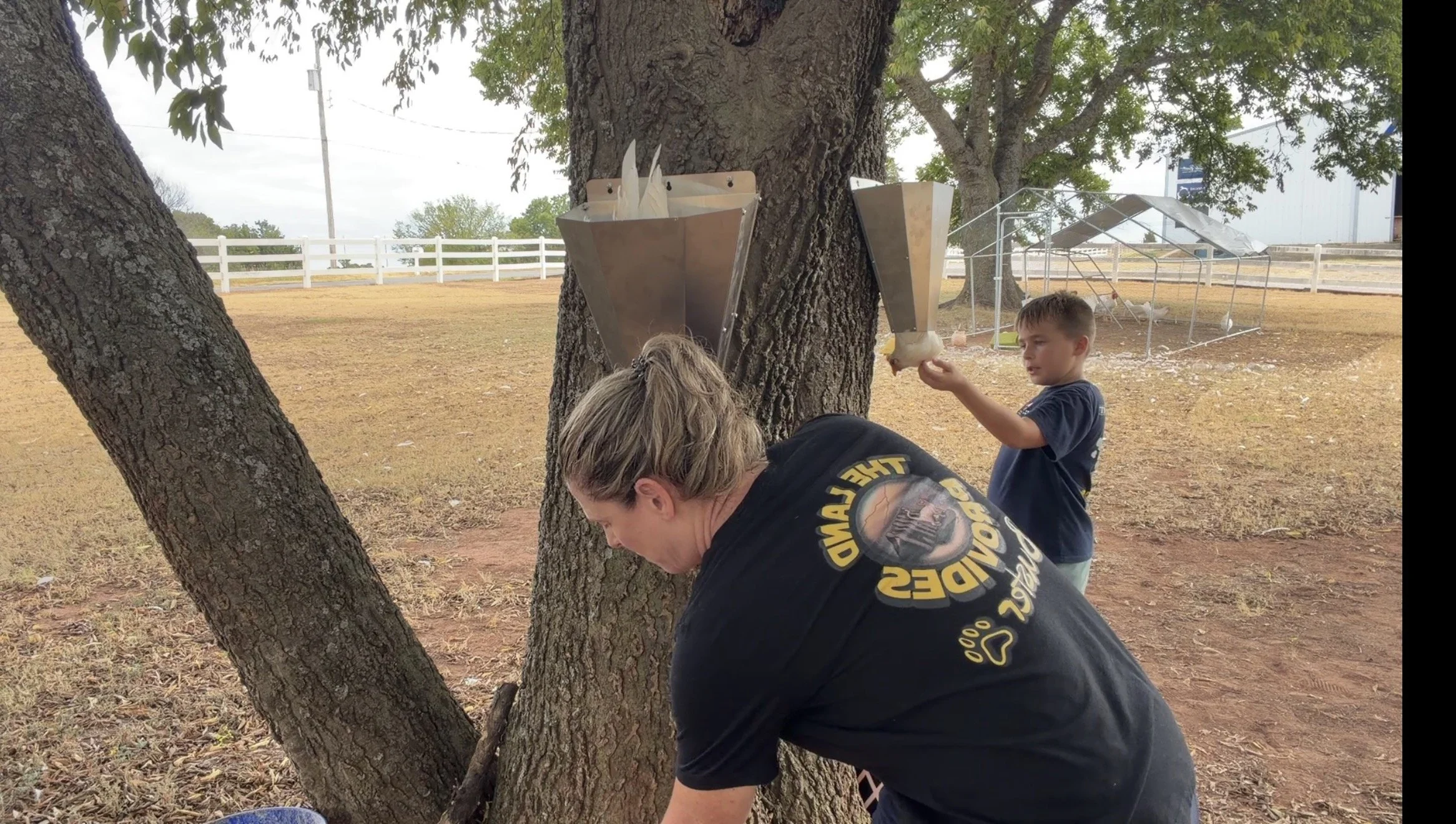
Before Kristina dispatched each chicken, Dimitri insisted on giving it a little neck massage while it rested in the processing cone.
It was one of the sweetest and most unexpected moments of the day.
There he was, eight years old, gently petting and massaging each chicken and making sure it seemed calm before stepping away.
Then, once each bird was dispatched, Dimitri carried it over to the processing area.
For someone seeing the process for the first time, he may have been one of the calmest people there.
It was also a good reminder that understanding where food comes from does not mean becoming disconnected from the animal.
For us, it means the opposite.
Scalding, Plucking, and Finding Our Rhythm
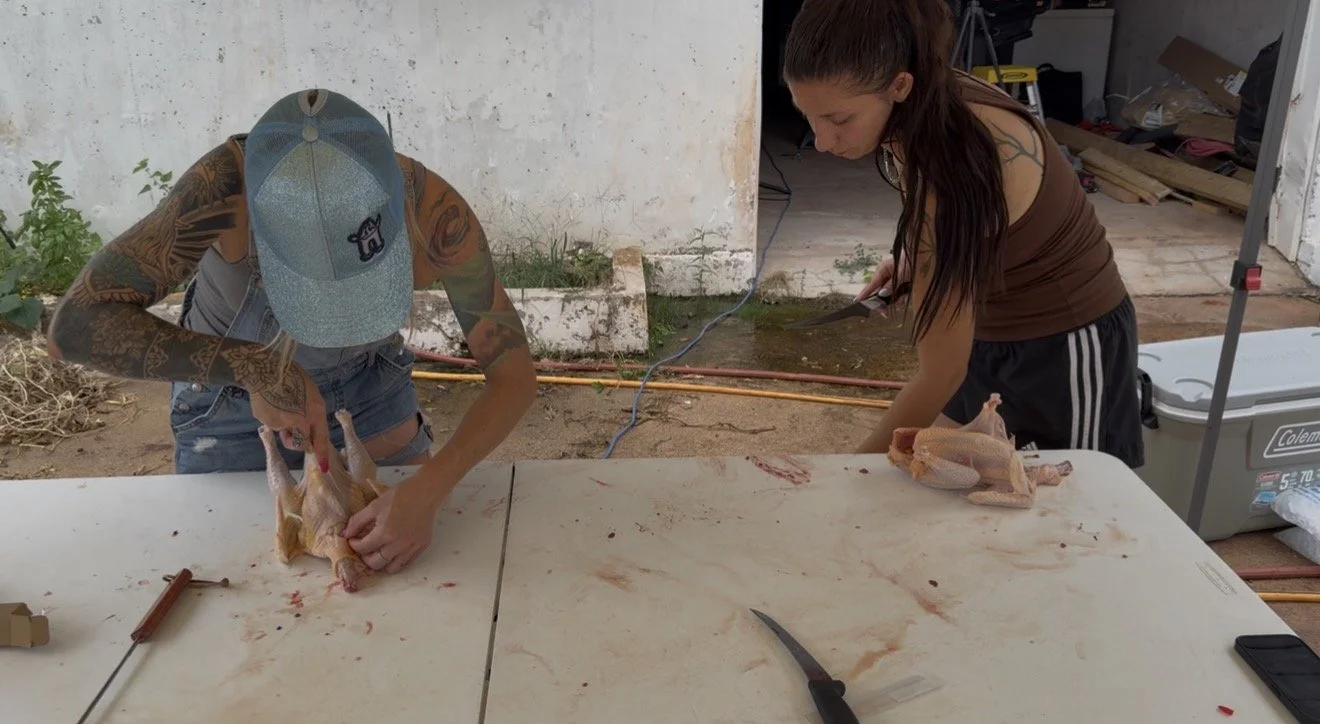
From there, Arianna, Daniela, and Philip worked together through the hands-on processing.
Arianna and Daniela handled much of the scalding and cleaning, while Philip was right in the middle of the process with them—helping move birds through each stage, operating and assisting with the plucker, removing remaining feathers, helping with butchering, and stepping in wherever another set of hands was needed.
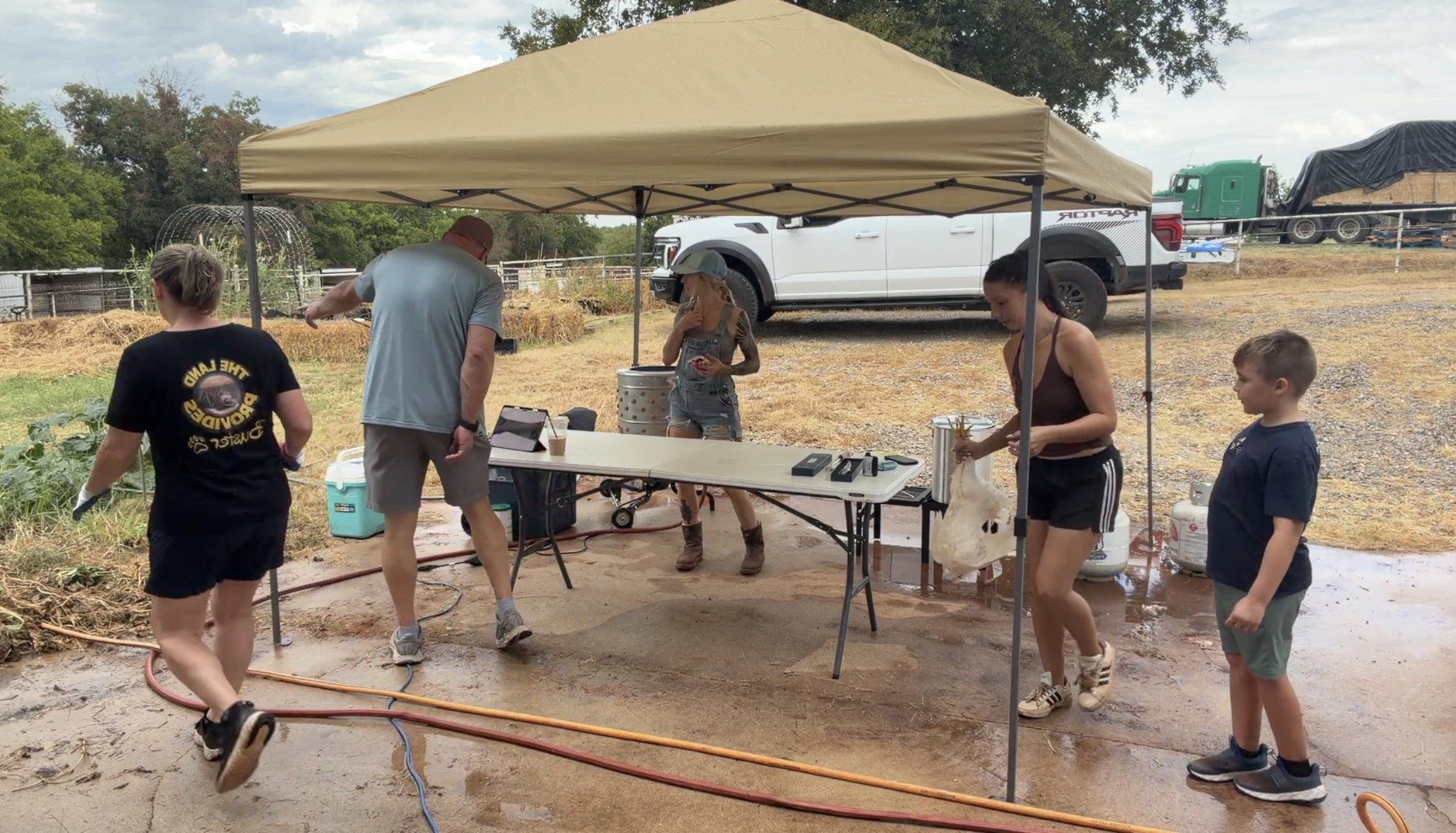
We set up the entire processing area outdoors under a canopy with tables, hoses, coolers, propane burners, the scalder, and our Yardbird chicken plucker.
It looked a little like a farmyard assembly line.
And after the first few birds, that is exactly what it became.
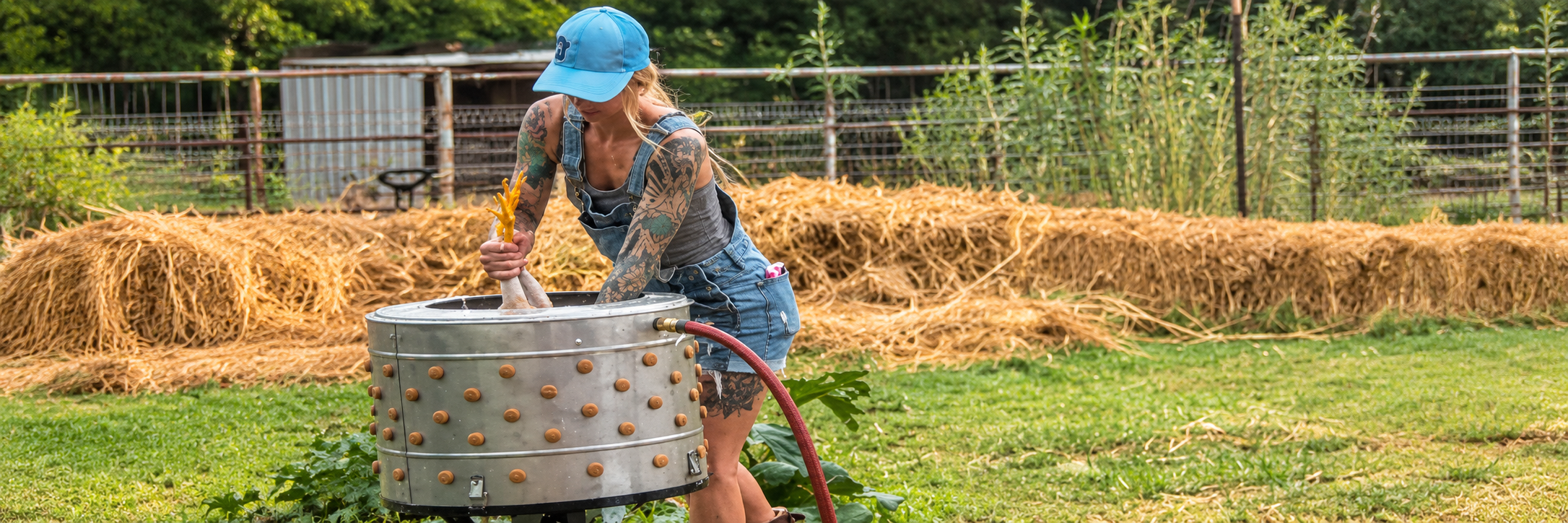
Once each chicken was properly scalded, it went into the plucker.
If you have never watched a mechanical chicken plucker work, it is strangely satisfying.
The drum spins, rubber fingers remove the feathers, and within a surprisingly short amount of time, a fully feathered chicken becomes a mostly featherless one.
It made us appreciate the equipment immediately.
Philip was not simply standing by keeping the machinery running. He was actively processing chickens right alongside Arianna and Daniela.
He helped with the plucker, defeathering, moving birds to the tables, butchering, cleanup, and keeping the flow moving from one stage to the next.
At the same time, he was still the person everyone looked to when a hose kinked, a propane setup needed attention, or a piece of equipment decided not to cooperate.
So his unofficial job title became something along the lines of processing crew, maintenance department, and general problem solver.
The Less Glamorous Part
Once the feathers were removed, the birds moved to the processing tables.
Arianna, Daniela, and Philip worked together on the cleaning, evisceration, and final processing of the birds.
There is no especially elegant way to describe this part.
It is messy.
It takes concentration.
And the first few chickens definitely took longer than the last few.
But one of the most interesting things about the day was watching everyone become more comfortable with their role.
At the beginning, every step required thought.
By the end, we had a system.
Kristina was dispatching.
Arianna, Daniela, and Philip were the processing crew.
Dimitri was transportation and chicken relaxation services.
And then there was management.
Binx, Farmstead Poultry Processing Supervisor
Our farm cat, Binx, followed us around for almost the entire day.
Not casually.
He was invested.
He watched people moving chickens from one station to another.
He watched the scalder.
He watched the plucker.
He watched the processing tables.
And we are fairly certain that, from his perspective, the entire family had finally come to its senses and organized an enormous chicken buffet specifically for him.
It must have been deeply disappointing when he realized that was not the plan.
We could not decide whether he was fascinated, concerned, or simply calculating how many meals 22 chickens represented.
Knowing Binx, probably the last one.
He has since been promoted to Farmstead Poultry Processing Supervisor, although his compensation package remains under negotiation.
Into the Ice Bath
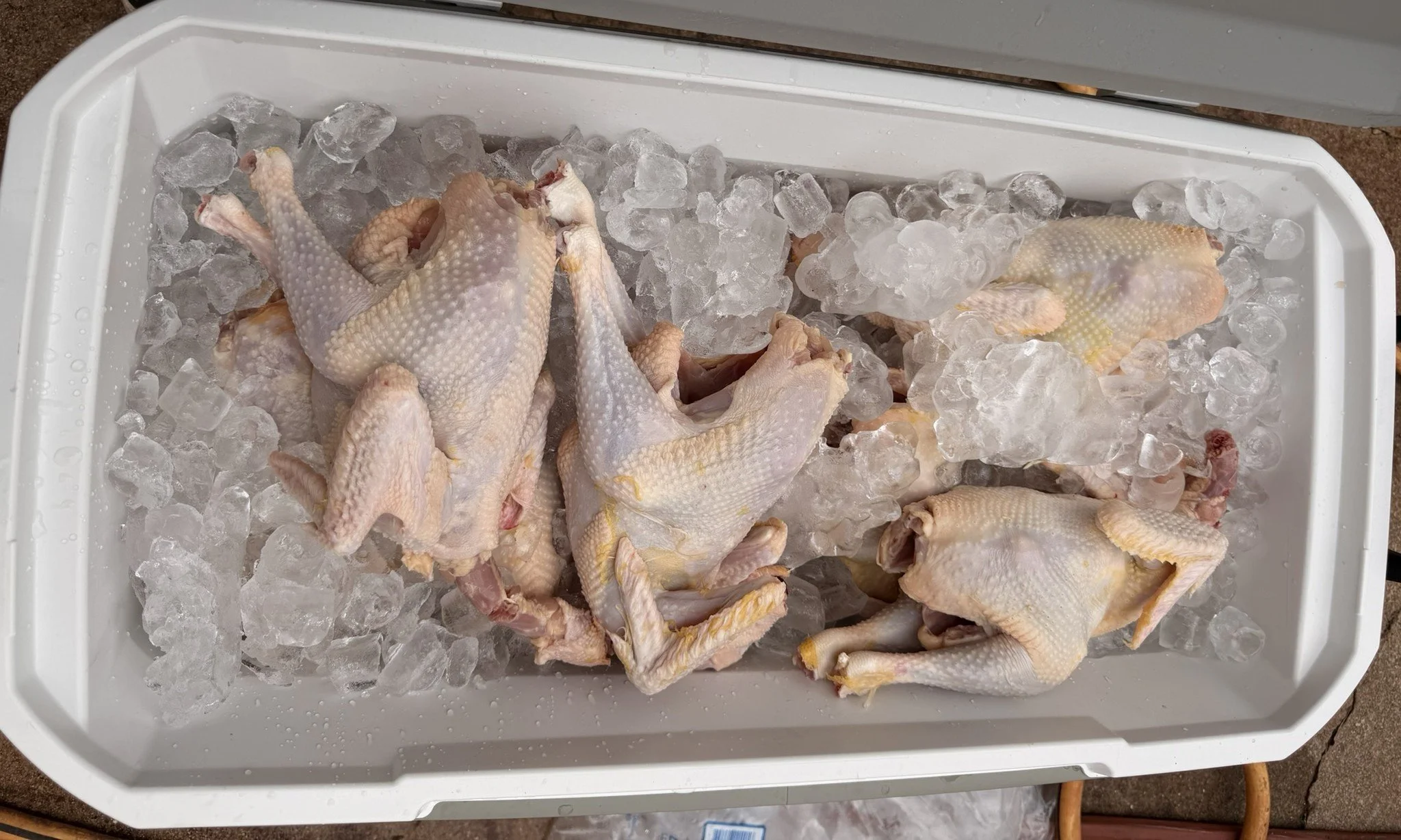
As each bird was cleaned, it went into a large ice-water bath to begin chilling.
By the time we finished the flock, we were wet, tired, and surrounded by hoses, coolers, buckets, folding tables, propane tanks, and processing equipment.
The photos probably tell the story better than anything else.
This was not a perfectly staged homesteading photo shoot.
There were hoses everywhere.
The concrete was wet.
Equipment had been moved around.
Everyone was working.
There was cleanup to do.
There were a few moments of confusion.
There was also a lot of laughing.
And that was one of our favorite parts of the day.
It felt real.
From Chicken to Freezer
We left the chickens chilled overnight.
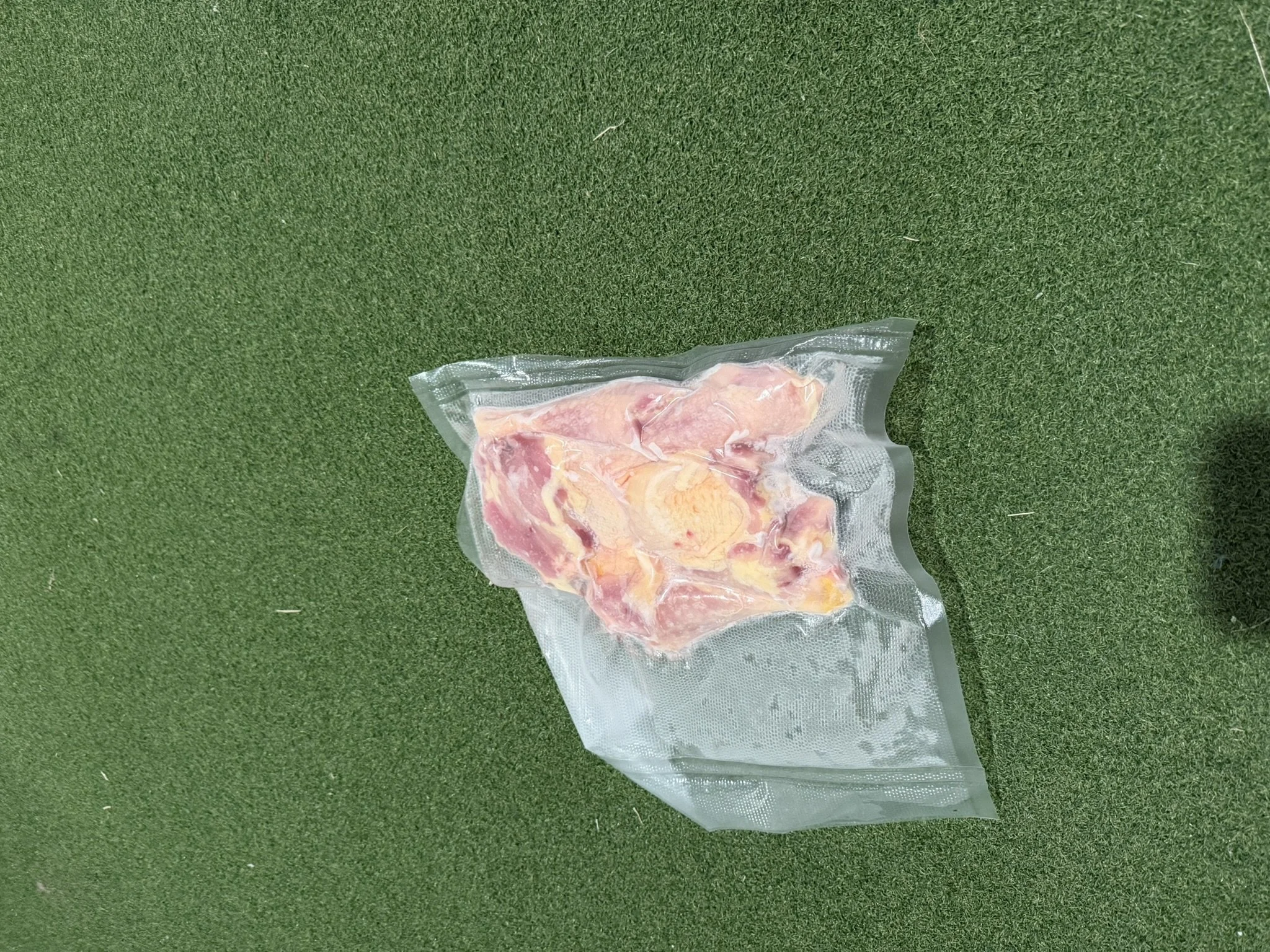
The following day, we removed them from the water, dried them, and cut them into the portions our family uses most often.
Everything was then vacuum-sealed and frozen.
That was probably the moment when the whole experience really came together.
These were chickens we had raised ourselves.
We knew what they ate.
We knew how they were cared for.
We knew who processed them.
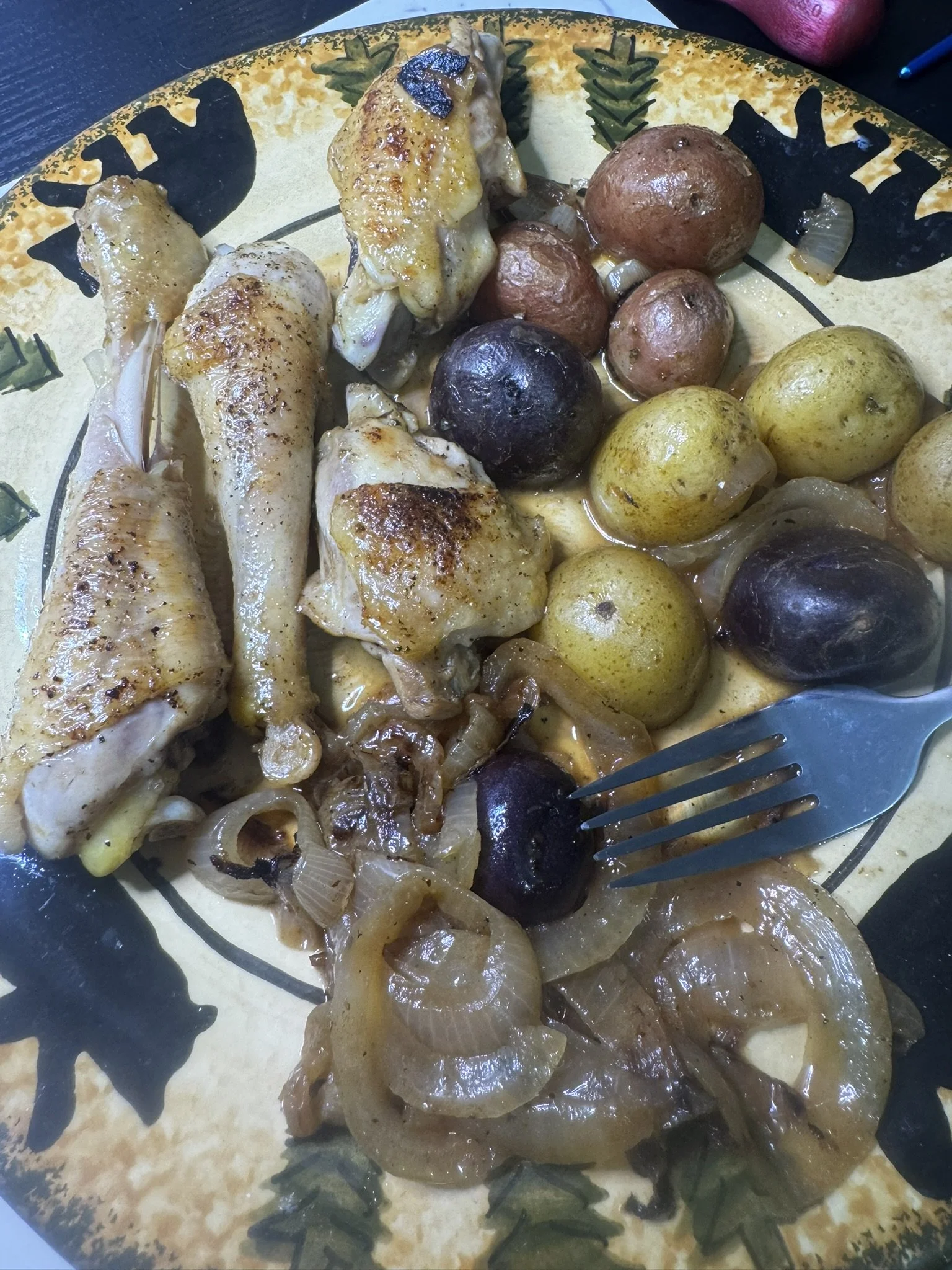
And now they were neatly packaged and going into our freezer to feed our family.
There is something very satisfying about that.
It gives you a different appreciation for food when you understand how much work happened before it reached the dinner table.
What We Learned From Our First 22 Chickens
Our first processing day taught us a lot.
We learned that having assigned jobs makes the process much smoother.
We learned that the processing cones worked well for us and helped keep the process controlled.
We learned that a mechanical plucker saves a tremendous amount of time.
We learned that our outdoor setup worked, although there are already a few things we will arrange differently next time.
And we learned that while Delawares produced excellent meat for our family, we want a larger, more efficient meat bird for the next flock.
That brings us to what is coming next.
Next Up: 40 Cornish Cross Chickens
Our next flock will be 40 Cornish Cross chickens.
Cornish Cross are bred specifically for meat production and grow much faster and larger than a dual-purpose chicken like the Delaware.
Our hope is that they will be ready for processing in approximately 7 to 8 weeks, depending on their growth and condition.
Because we are heading into winter, this next batch will primarily be for our own family.
The goal is simple:
Fill the freezer.
We want to raise enough chicken to supply our family through a good portion of the winter.
And after processing our first flock, we feel much better prepared.
Everyone knows their job now.
Arianna, Daniela, and Philip know how to move the birds through the processing line much more efficiently.
Philip already knows which equipment will probably need his attention before anyone else realizes there is a problem.
Dimitri knows that chicken massage is apparently part of his official farm duties.
And Binx has made it very clear that he is available for the next processing day.
After That, We Begin Raising Chicken for the Farm Store
The next stage is especially exciting for us.
We are currently developing the Rein Maker Ranch Farmstead app and farm store.
Eventually, customers will be able to see what we are growing, raising, producing, and making here at the farm.
One of the products we plan to offer is farm-raised chicken.
Our plan is to begin with a preorder model.
Instead of raising large numbers of birds and hoping they sell later, customers will be able to reserve chicken from an upcoming flock through the farm store.
That will allow us to raise based on actual demand, keep the operation small and manageable, and reduce unnecessary waste.
When the chickens are ready, customers will be able to purchase and pick up their orders directly from the farm.
This Is What Farmstead Means to Us
When we first started developing Rein Maker Ranch Farmstead, the goal was never simply to grow a garden or keep a few chickens.
We wanted to become more involved in producing the food our family eats and to better understand the work behind it.
That means learning things previous generations often knew naturally but many of us have never had to think about.
Which chicken breeds work best for meat?
How much feed does a flock require?
How long does it take to raise them?
How do you process and preserve the food you produce?
How much chicken does your family actually eat in a year?
You look at food differently when you are involved in every step.
And you also quickly realize that real farmstead life is not nearly as polished as it sometimes appears online.
Sometimes it is beautiful gardens and fresh eggs.
Sometimes it is five family members standing under a pop-up canopy with a chicken plucker, coolers, propane burners, garden hoses, and one farm cat who is convinced the entire operation exists for his benefit.
Sometimes it is an 8-year-old boy who grew up near the beach in Florida standing beside a tree in Oklahoma, giving a chicken a neck massage because he thinks it deserves a little kindness before becoming dinner.
Both are farmstead life.
And we like it that way.
Our first flock of 22 Delaware chickens was just the beginning.
We learned a lot.
We will change a few things next time.
We will probably get much faster.
But when we finally sat down and ate that first chicken, knowing exactly where it came from and knowing our family had done the work together from beginning to end, it felt like an important milestone.
Because Rein Maker Ranch Farmstead is not just something we are planning anymore.
We are actually building it.
One garden.
One flock.
One freezer full of chicken.
One 8-year-old chicken masseuse.
And one extremely hopeful farm cat at a time.
Next up: 40 Cornish Cross chickens, another processing day in about 7 to 8 weeks, and the next step toward opening the Rein Maker Ranch Farmstead store.
About Rein Maker Ranch Farmstead
Rein Maker Ranch Farmstead is our family farmstead in Purcell, Oklahoma, where we are learning to raise more of our own food, grow produce, raise poultry and livestock, and share the process as we build toward opening our local farm store.

The Rein Maker Journal
Follow Rein Maker Farmstead near Purcell, Oklahoma as we grow. Get farm updates, seasonal products, class announcements, events, and behind-the-scenes stories from the ranch.
Farmstead News, Classes & Life at the Ranch
Follow the transformation of Rein Maker Ranch as we build Rein Maker Farmstead in the Purcell, Oklahoma area.
We're documenting the process as it actually happens—from pasture regeneration and planting our first crops to raising livestock, learning traditional farmstead skills, developing farm-fresh products, and preparing for our expanded farmstead operations in 2027.
Along the way, we'll share what works, what doesn't, what we're learning, and what's coming next.
Join the Rein Maker Farmstead Newsletter
Want to follow along?
Follow our Facebook page for farmstead updates, upcoming classes, seasonal products, special events, and occasional behind-the-scenes news from Rein Maker Ranch.
You’ll be among the first to hear about:
Farm-fresh produce and seasonal availability
Dairy and farmstead product launches
Homesteading and cheesemaking classes
Workshops and educational events
New livestock and farmstead projects
Strawberry and garden harvests
Special farm events
Rein Maker Farmstead's 2027 expansion
Click Here to Follow Us on Facebook: Rein Maker Ranch Facebook Page
Follow Our Farmstead Journey
We're not starting with a finished farm and pretending you missed the hard part.
We're inviting you to watch us build it.
The Rein Maker Journal will document the evolution of our Oklahoma farmstead—from improving the soil and establishing crops to livestock, food production, classes, and the everyday realities of building a more sustainable life on the land.
From Performance Horses to a Family Farmstead
The story of how decades spent with horses, ranching, business, and equine rehabilitation led our family toward regenerative agriculture and the development of Rein Maker Farmstead.
Read Our Story →
Building Rein Maker Farmstead
Follow the projects, decisions, successes, mistakes, and lessons that go into transforming Rein Maker Ranch into a working Oklahoma farmstead.
From Our Pastures & Gardens
Follow what's growing throughout the seasons, including vegetables, berries, pasture improvements, and future farm-fresh products.
From the Barn
Meet the animals that call Rein Maker Farmstead home and learn about the role livestock plays in our approach to land stewardship.
Classes & Events
Learn about upcoming hands-on opportunities including homesteading, food preservation, cheesemaking, gardening, livestock care, and other traditional farmstead skills.
What's Available From the Farm
As production grows, we'll share seasonal availability of produce, farmstead foods, and other small-batch offerings here first.
Rein Maker Farmstead — Growing in Oklahoma
Rein Maker Farmstead is being developed at Rein Maker Ranch in the Purcell, Oklahoma area of McClain County, approximately 45 minutes south of Oklahoma City.
Our family is building the farmstead around responsible animal care, regenerative land management, locally produced food, practical education, and a desire to become better stewards of the land we're fortunate enough to call home.
Learn About Rein Maker Farmstead
Meet the Family Behind Rein Maker Ranch
Be Part of What Comes Next
The farmstead is still growing—and that's exactly why this is a good time to join us.
Subscribe to the Rein Maker Farmstead Newsletter and we'll let you know when something worth sharing happens.