
Building Our Strawberry Field: 900 Plants, Five Rows, and a Lot of Mud
There are projects that sound very simple when you explain them in one sentence.
“We’re planting strawberries.”
That sounds easy enough.
It does not sound like six people, one friend, a tractor, a disc, an arena drag, poly tubing, plastic mulch, Oklahoma wind, several hours of manual labor, mud up to our ankles, and one family member suggesting we should all probably be dewormed afterward.
But that is, in fact, how we planted our first strawberry field.
Our goal was simple:
Five rows.
100 feet each.
900 strawberry plants.
And somehow, by Saturday, October 24, we got it done.
Step One: Do We Even Have Water?
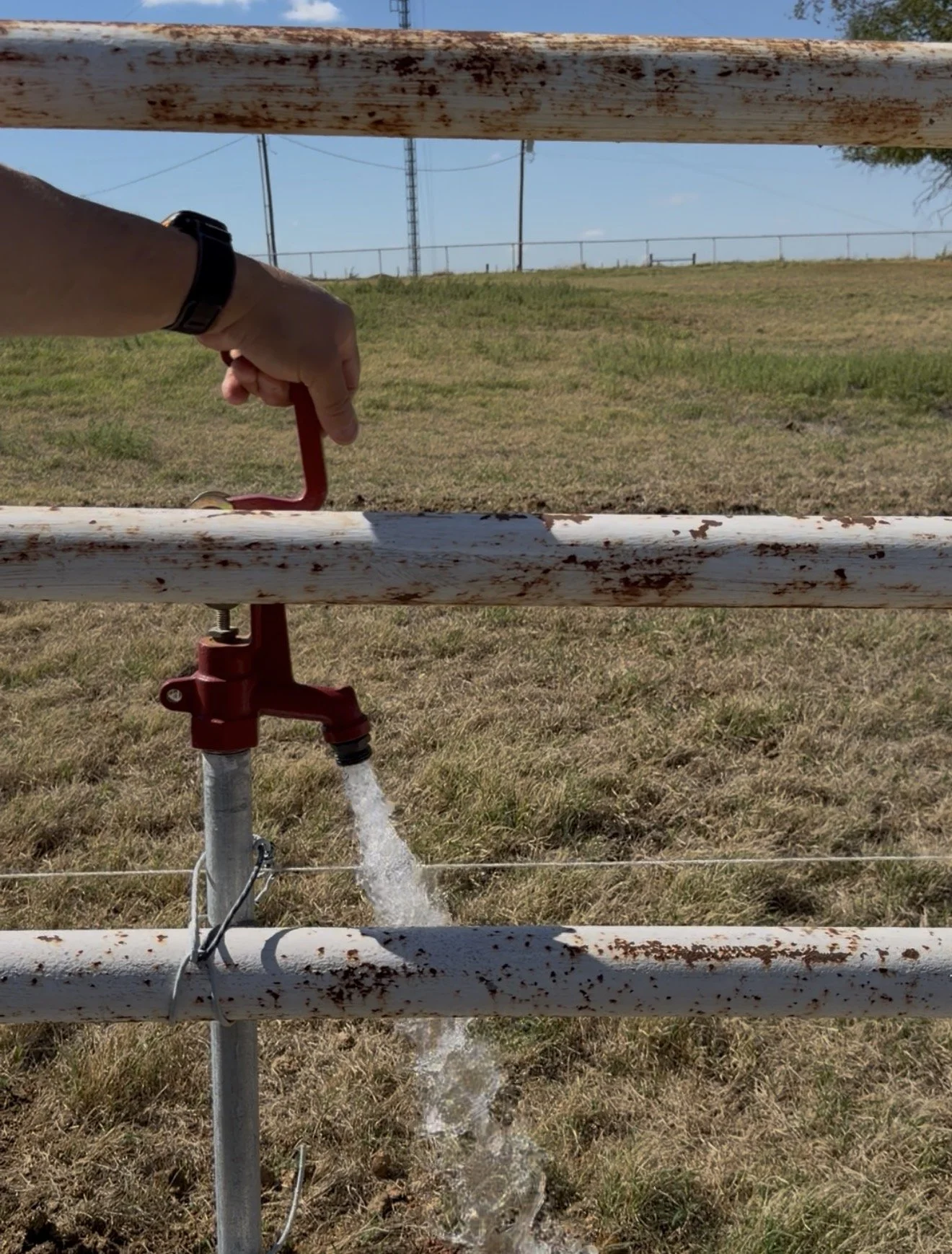
Before we worried about tractors, rows, irrigation, or plastic mulch, we had to answer one very basic question:
Do we actually have water where we need it?
We drove up to a spigot near the field that looked like the best option for connecting our irrigation system.
This was one of those moments where farm planning becomes very practical very quickly.
Before you build 500 feet of strawberry beds, it is generally a good idea to make sure the water source exists.
Fortunately, it did.
Not only did we have water, but the pressure was good.
Excellent.
One problem eliminated.
Approximately 47 remaining.
Preparing the Field
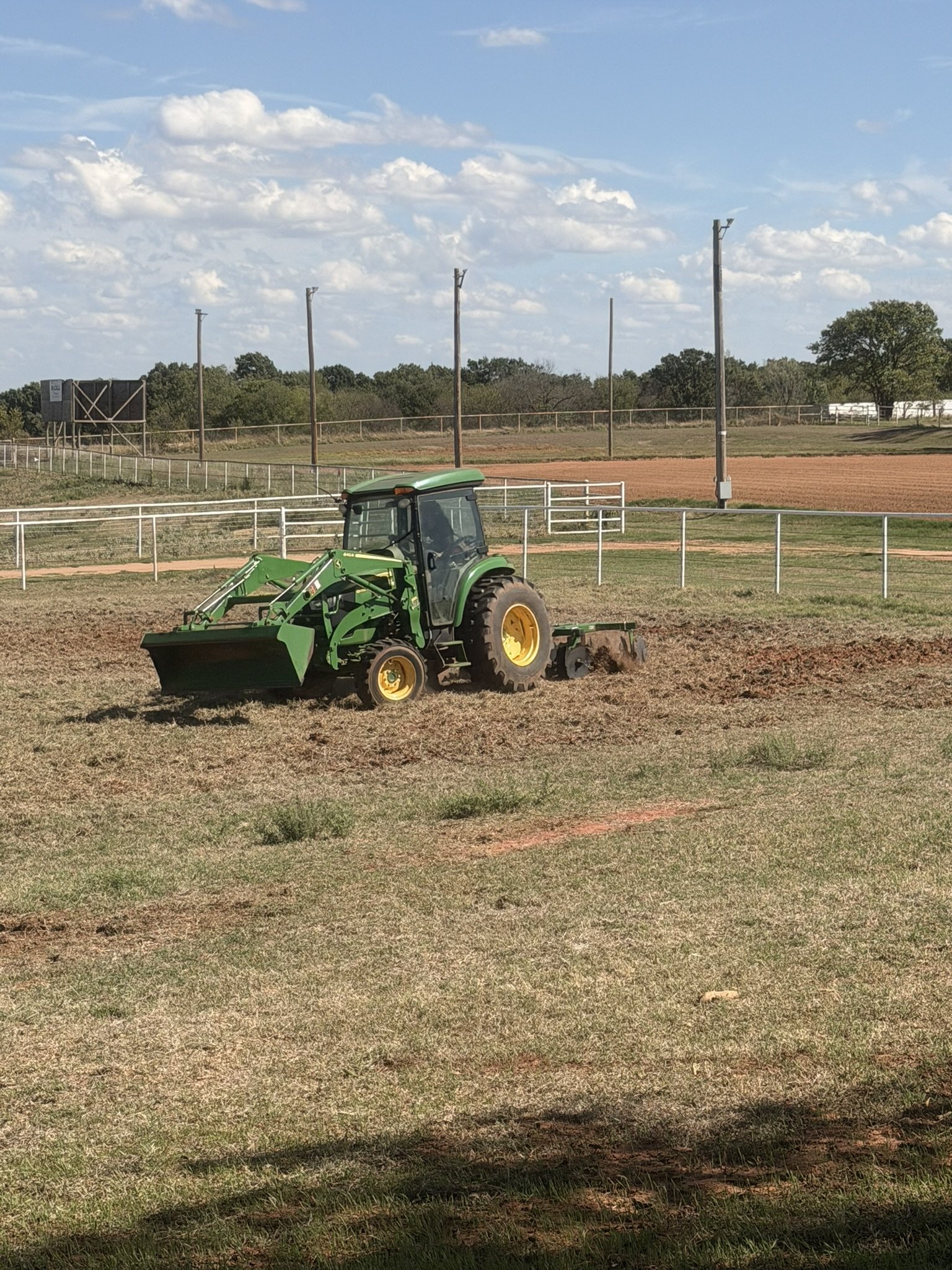
The strawberry area started as grass.
A lot of grass.
We did not want to deeply plow the field, so the first step was to use a disc harrow attachment behind the tractor.
The discs cut into the surface, broke up the grass, loosened the top layer of soil, and started preparing the ground for the beds.
This required some adjusting.
And by “adjusting,” we mean there is a photo of Daniela standing in the field with what looks very much like a crowbar trying to convince the disc to cooperate.
Farm equipment is wonderful.
Farm equipment also occasionally requires negotiation.
Once the disc had done its job, we followed with the arena drag we normally use for the horse arenas.
That pulled up more grass, worked the soil further, and helped smooth and level the field.
At this point, things were beginning to look promising.
Which is usually when we become overly confident.
Surely We Can Just Build the Beds by Hand
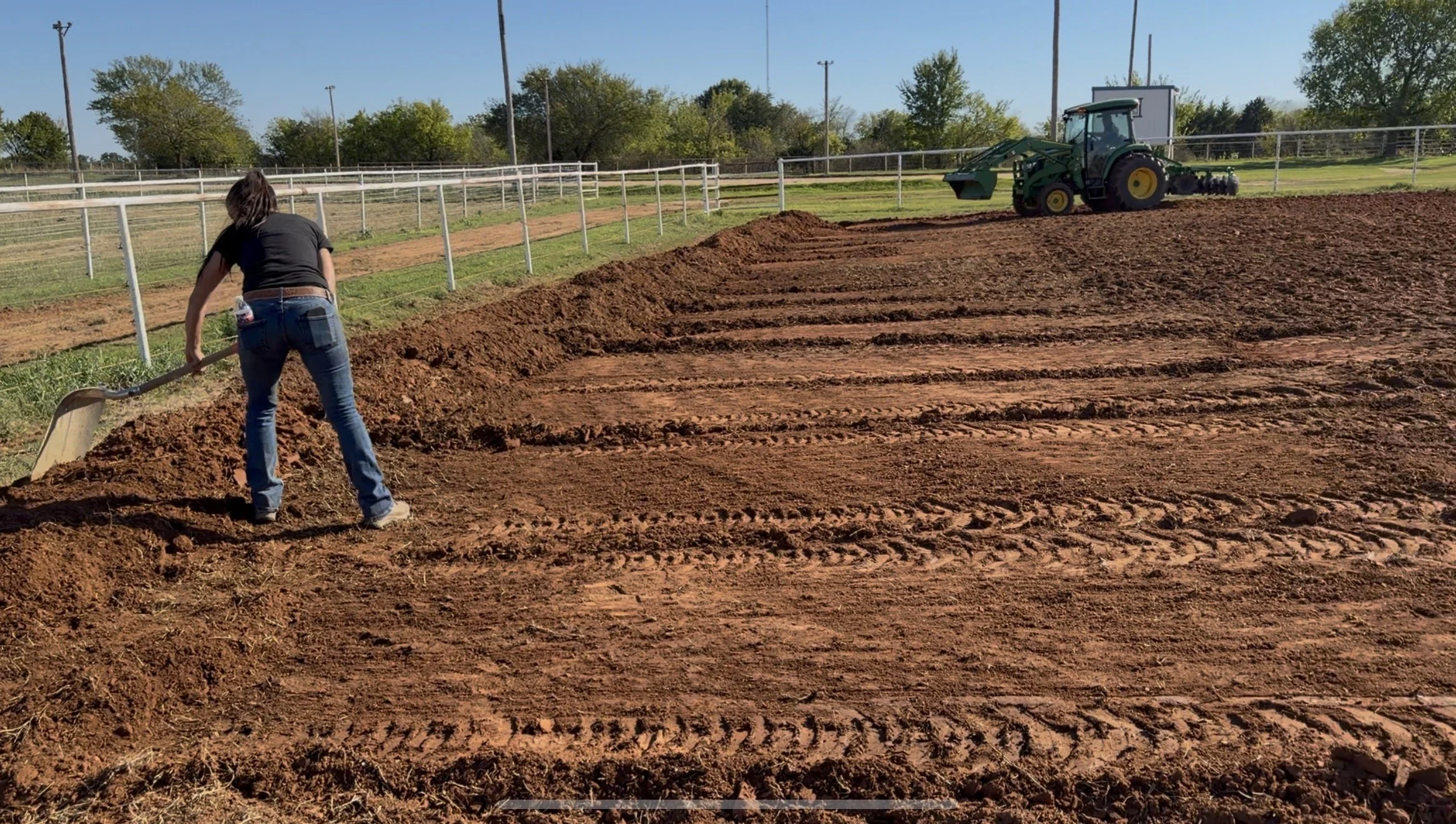
The plan called for five raised beds approximately 30 inches wide, with roughly three feet between each row.
Our first approach was very reasonable.
We decided to build them manually.
With shovels.
Five.
Hundred.
Feet.
Daniela was shaping the beds by hand while Phil moved dirt around, and for a while we were all apparently committed to proving that modern agricultural equipment was unnecessary.
We bent over.
We shoveled.
We shaped.
We reshaped.
We stared at the rows.
We moved more dirt.
And eventually the obvious question occurred to us:
Why are we doing this by hand when there is a tractor sitting right there?
This question would have been more useful approximately two hours earlier.
The Tractor Bucket Saves the Day
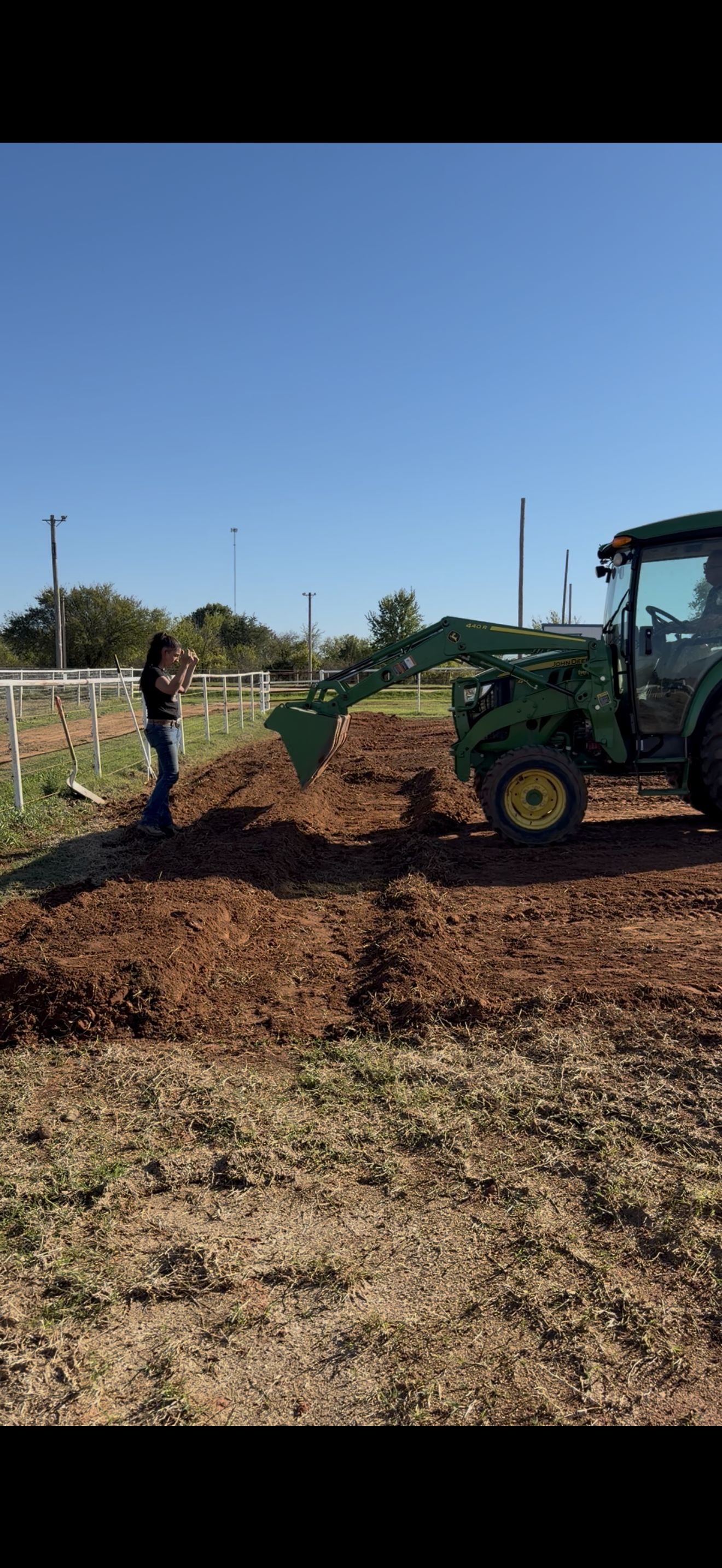
Once we stopped trying to recreate agricultural life from 1890, things improved dramatically.
Phil got into the tractor.
Daniela stood in the field directing traffic.
A little more dirt here.
Less there.
Wider.
Flatter.
Move over.
Back up.
Try again.
And suddenly the tractor bucket was doing in minutes what we had been attempting to accomplish manually.
Daniela still did some final shaping with a flat shovel, but the majority of the heavy work was now being done by the machine specifically designed to move dirt.
Revolutionary.
We also discovered that our supposedly 30-inch beds were not exactly 30 inches.
Some were probably closer to 36 to 40 inches wide.
At the time, this felt like a mistake.
Later, it turned out to be one of the luckiest mistakes of the entire project.
More on that shortly.
Then Came Irrigation
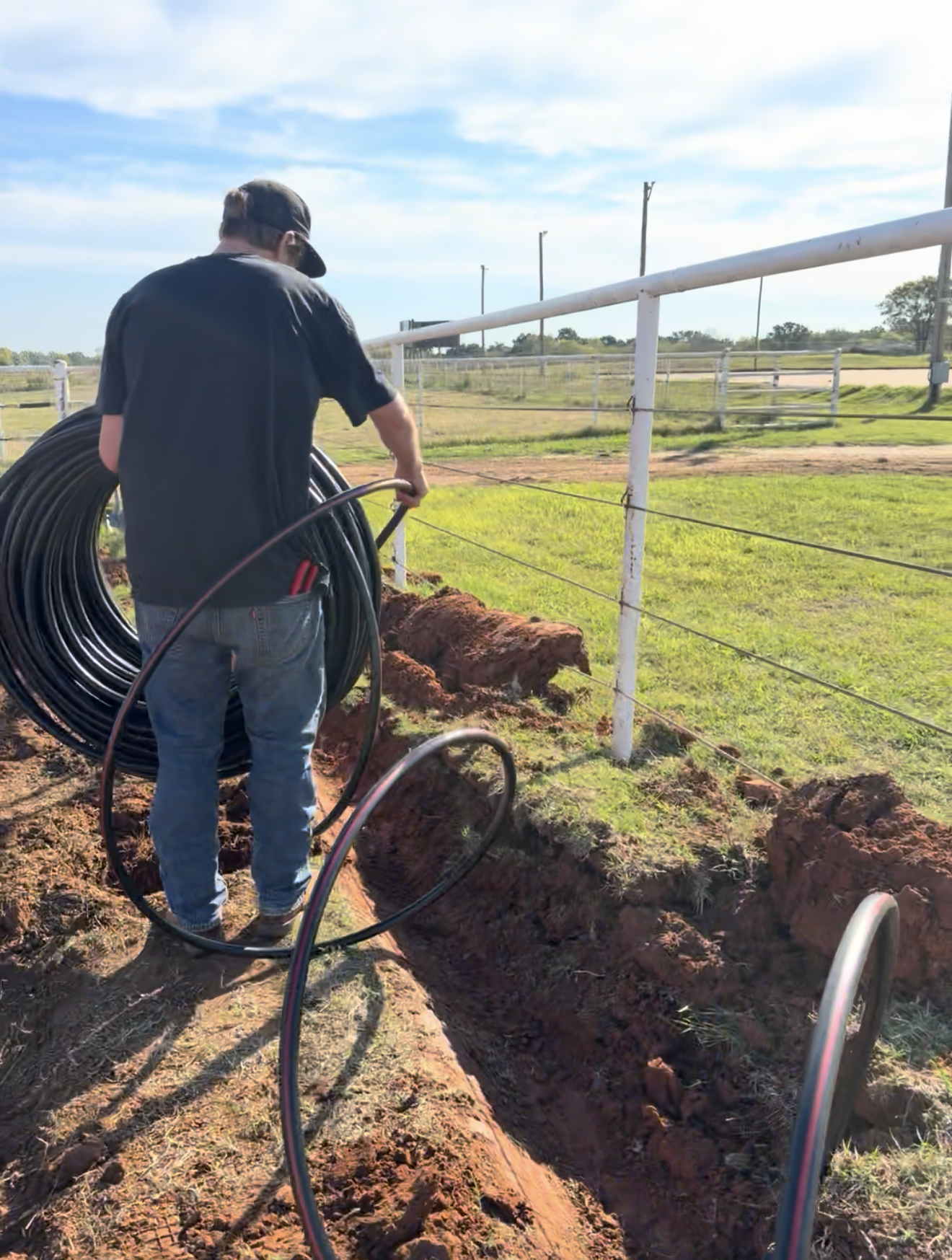
Once the beds were formed, we needed to install irrigation before covering everything with plastic mulch.
Our friend Taylor came out to help us plan and install the system.
Originally, we intended to use drip tape.
That was the plan.
And like many farm plans, it lasted right up until we tried to actually buy the materials.
We could not get the drip tape we wanted locally in time.
Normally, we might have waited.
Unfortunately, a large amount of rain was expected, and the strawberry plants needed to get into the ground before the weather changed.
So waiting was not really an option.
We switched to poly tubing instead.
The tubing was laid underneath where the plastic mulch would go, and we tested the system to make sure water was actually moving through the rows.
It worked.
Which briefly gave us the dangerous feeling that we had everything under control.
Then we started laying plastic.
Plastic Mulch Versus Oklahoma Wind
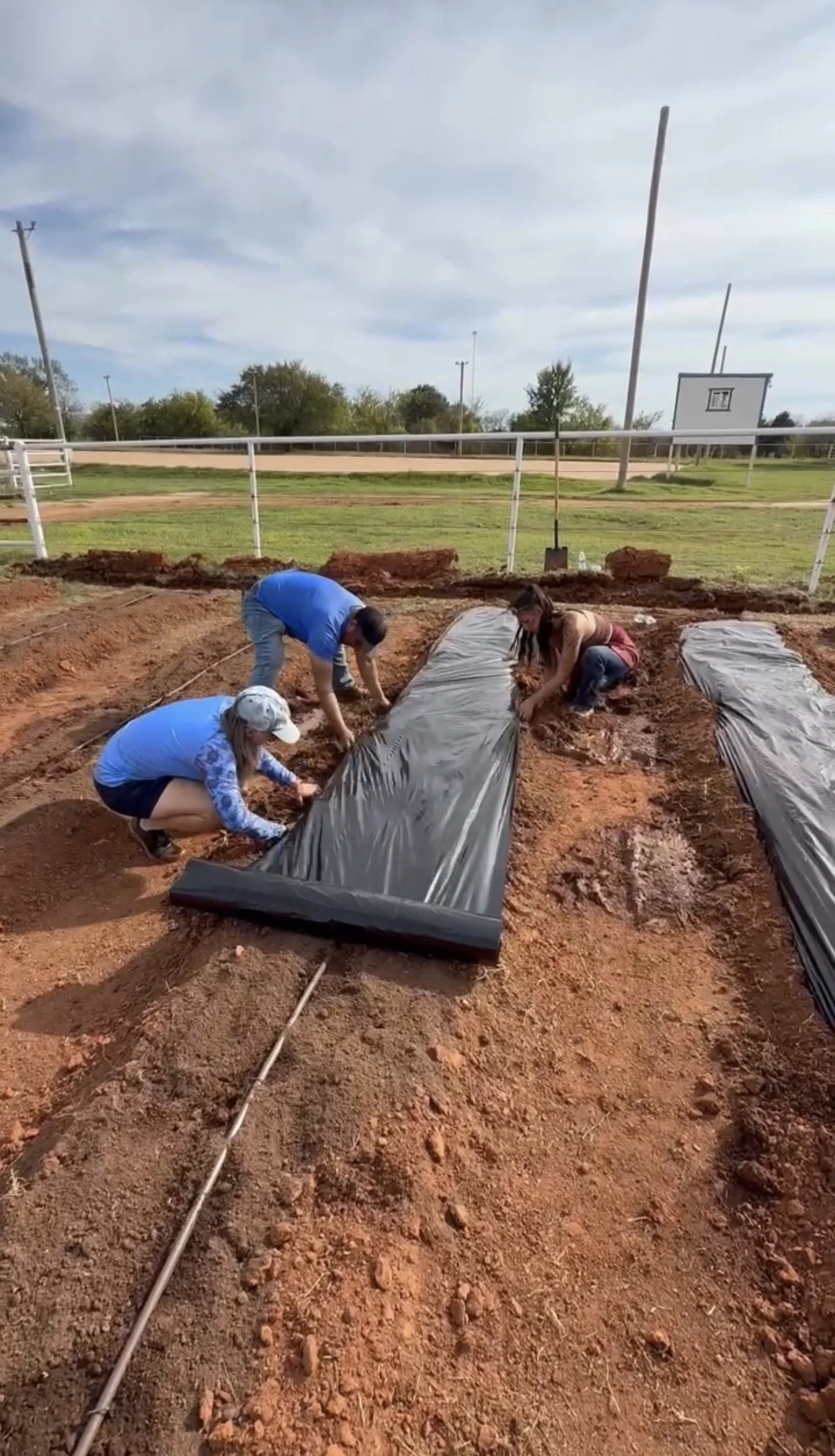
Each raised bed needed to be covered with black plastic mulch.
The idea is straightforward.
Stretch the plastic tightly over the bed.
Bury the edges.
Plant the strawberries through holes in the plastic.
Simple.
Except plastic mulch is essentially a giant 100-foot sail.
And we live in Oklahoma.
Four people would stretch and position the plastic while the wind attempted to relocate it to another county.
The plastic needed to be pulled as tightly as possible so it would sit firmly against the soil and not flap, shift, or collect water.
So we developed a system.
Pull.
Hold.
Tuck.
Bury.
Move forward.
Repeat.
Approximately forever.
The Part Where We Questioned All of Our Life Choices
This turned out to be the hardest physical part of the entire project.
The edges of the plastic had to be buried so they would stay secure.
We did not use equipment for this.
We did it by hand.
That meant pulling soil away from the sides of the raised beds, tucking the plastic down into the trench, pushing the soil back over it, and packing everything tightly enough that the Oklahoma wind would not immediately undo our work.
Over.
And over.
And over.
For 500 feet.
This was also the moment when our accidentally oversized strawberry beds suddenly became very useful.
Because the rows had ended up closer to 36 to 40 inches wide instead of exactly 30, we had enough loose soil along the edges to pull away, tuck the plastic, and then push back over the top.
What had looked like imperfect measuring became a surprisingly helpful design feature.
We are choosing to call that foresight.
Then It Got Muddy
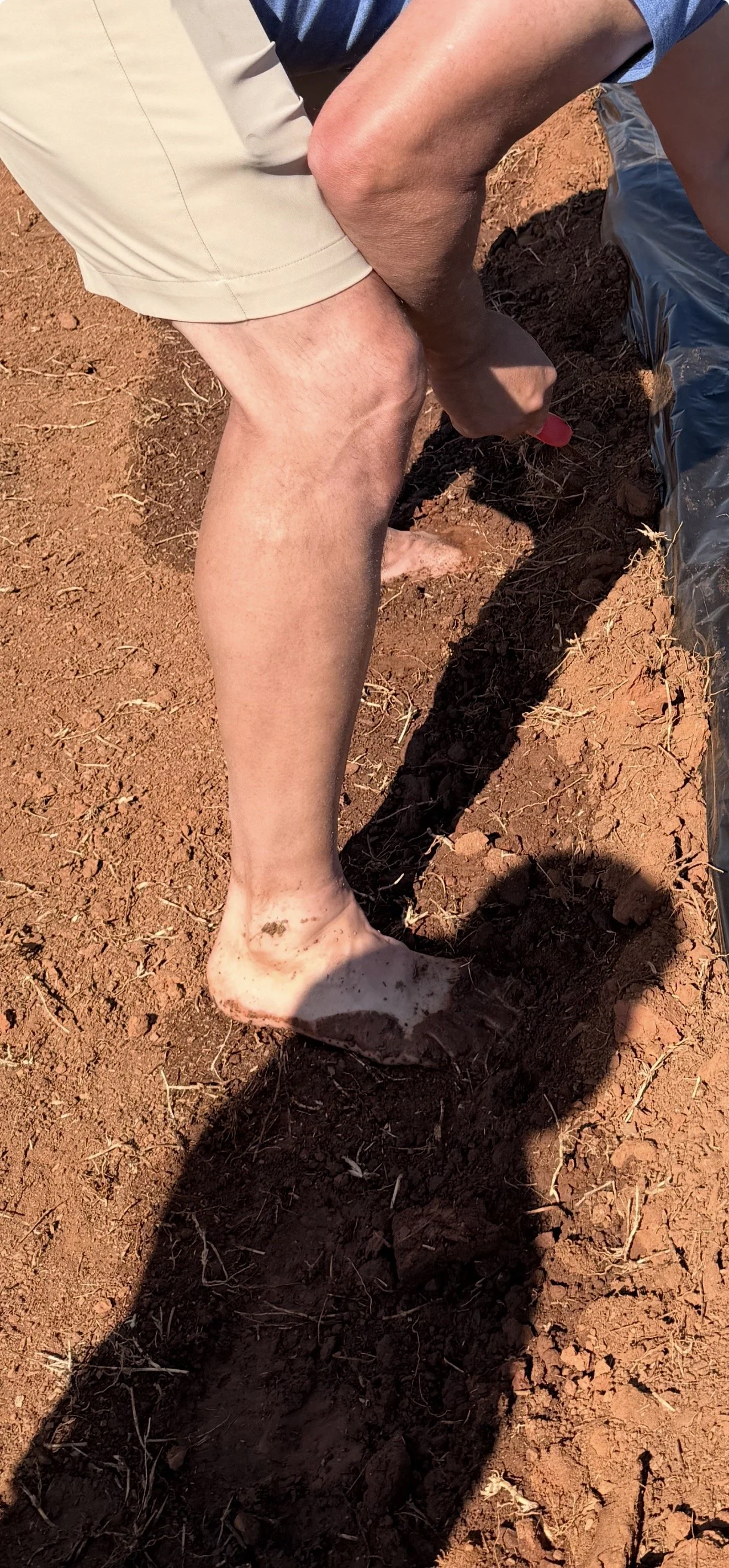
Once the irrigation was running, the field started getting wet.
Very wet.
And because we were working around newly formed beds, loose soil, irrigation lines, and freshly installed mulch, parts of the field quickly turned into mud.
There comes a point in every farm project when footwear becomes optional.
Several of us reached that point.
Shoes came off.
Bare feet went into the mud.
And we kept working.
This was when Arianna, observing the amount of direct contact we were having with wet soil, lovingly informed the family that we probably all needed to be dewormed afterward.
Thank you, Arianna.
Very comforting.
Finally: 900 Strawberry Plants
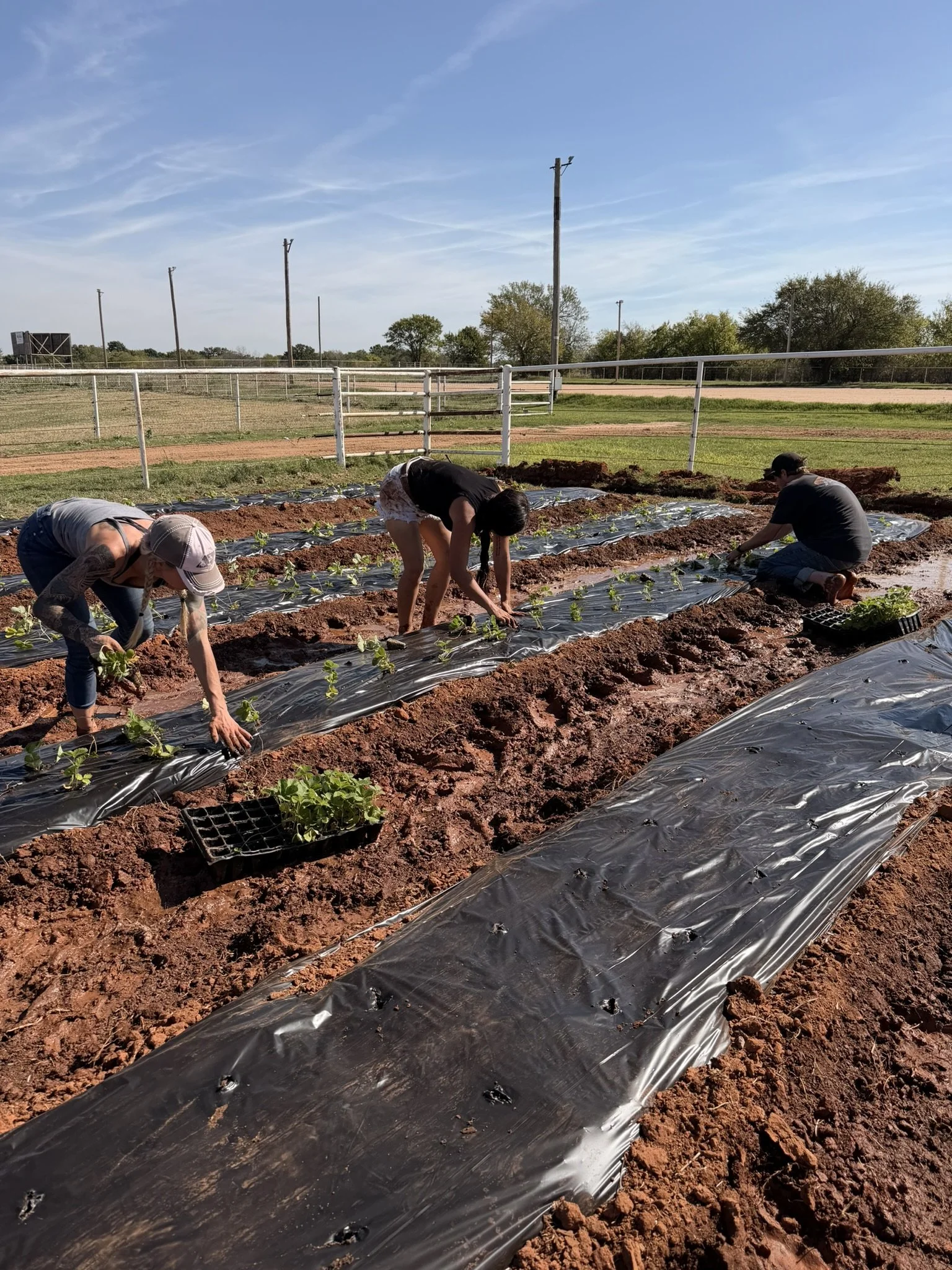
Once the field preparation, irrigation, and plastic mulch were finished, it was finally time for the part we had supposedly been doing all of this for:
Planting strawberries.
The whole family came together.
Daniela.
Kristina.
Arianna.
Philip.
Dimitri.
And Taylor.
Five rows.
100 feet each.
A total of 900 strawberry plants.
Plant by plant, we worked our way down the rows.
After days of dirt work, irrigation, plastic, wind, mud, and figuring things out as we went, seeing actual strawberry plants in the beds felt incredibly satisfying.
The field finally looked like a strawberry field.
Or at least the beginning of one.
We Even Have Room for More
We ended up with a little extra space at the end of one row.
We plan to use that area for additional plants grown from runners clipped from the strawberry plugs.
Which means our 900-plant strawberry field may not stay at 900 plants for very long.
Because apparently once you plant 900 strawberries, the obvious next step is more strawberries.
Meanwhile, the Cats Declined to Participate
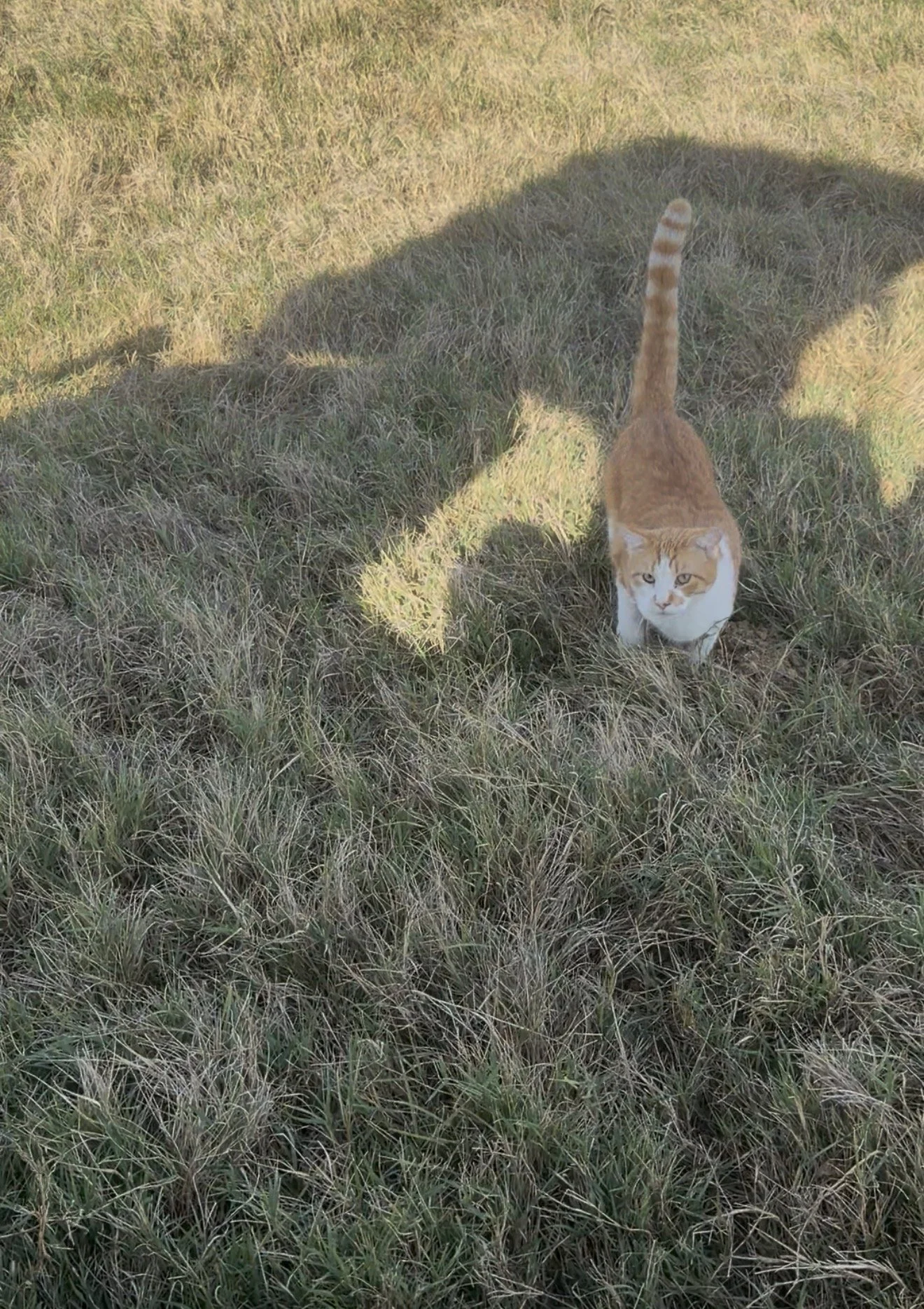
Anyone who followed our chicken-processing story may remember that Binx took his role as farm supervisor extremely seriously.
Not this time.
Binx runs the north side of the property near Daniela’s house and apparently decided the strawberry field was outside his jurisdiction.
Killer, who controls the south side of the property, was technically closer to the action.
She also declined.
Apparently strawberry planting did not meet either cat’s supervisory requirements.
So for once, we were unsupervised.
This may explain some things.
What We Learned From Building Our First Strawberry Field
We learned several useful things very quickly.
First, if there is a piece of equipment capable of doing the job, consider using it before spending several hours doing the same thing manually.
Second, Oklahoma wind and plastic mulch are natural enemies.
Third, irrigation should always be tested before everything is covered.
Fourth, beds that accidentally end up a little wider than planned may save you later.
And finally:
If six people spend enough time barefoot in a muddy strawberry field, somebody in the family will eventually suggest deworming everyone.
Apparently this is farm life now.
October 24, 2026: Planting Day
By Saturday, October 24, all 900 strawberry plants were officially in the ground.
Five rows.
100 feet each.
Irrigation underneath.
Plastic mulch secured.
Plants watered.
Mud everywhere.
Bodies exhausted.
Done.
And that last part felt very good.
A few days earlier, this was just a grassy field.
Then it became dirt.
Then raised beds.
Then irrigation lines.
Then plastic-covered rows.
And finally, a strawberry field.
Now comes the part we cannot control.
The weather.
Winter.
Rain.
Freezing temperatures.
Root development.
Plant survival.
And eventually, hopefully, flowers and strawberries.
If everything goes according to plan, these plants will establish through the winter and begin producing next spring.
Our goal is still the same:
Strawberries by May and our first Rein Maker Ranch Farmstead U-Pick event.
Of course, there are several months of Oklahoma weather standing between us and that goal.
So we will keep you posted.
Another Farmstead Milestone
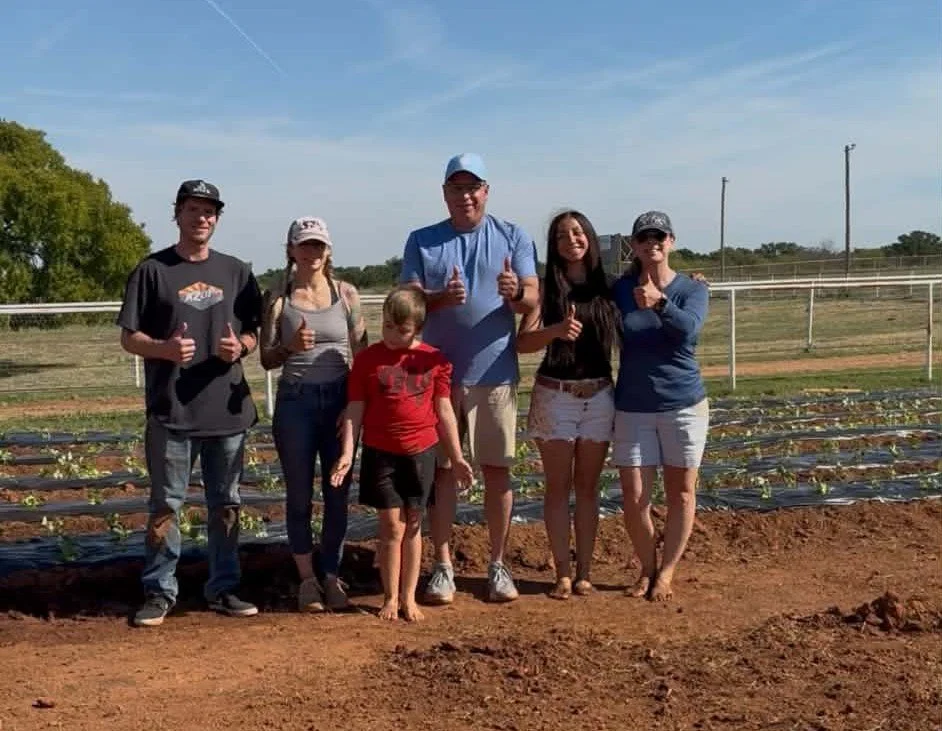
The strawberry field was probably one of the most physically demanding projects we have taken on so far.
It also taught us something we seem to learn repeatedly around here:
The first time you do something, you do not know what you do not know.
You research.
You plan.
You buy materials.
You think you understand the process.
Then you get into the field and discover that the tractor bucket would have saved you hours, your plastic mulch has become a kite, and half the family is barefoot in mud.
And somehow, you still finish.
That is becoming one of our favorite things about building Rein Maker Ranch Farmstead.
We are not waiting until we know exactly what we are doing.
We are learning by doing it.
Sometimes efficiently.
Sometimes the hard way.
Usually both.
Five rows. 500 feet of strawberry beds. 900 plants in the ground. One very muddy family. Zero interested cats.
And one more piece of Rein Maker Ranch Farmstead officially underway.
Watch the video of our journey here: From Reining Horse Pasture to 900 Strawberry Plants